concept transaction in category blockchain

This is an excerpt from Manning's book Blockchain in Action.
DESIGN PRINCIPLE 3 Define the data assets, peer participants, and their roles, rules to be enforced, and transactions to be recorded for the system you’ll be designing.

pragma solidity ^0.6.0;
contract AccountsDemo {

    address public whoDeposited;
    uint public depositAmt;
    uint public accountBalance;

    function deposit() public payable            #1
    {
        whoDeposited = msg.sender;               #2
        depositAmt = msg.value;                  #3
        accountBalance = address(this).balance;
    }
}
You’ve been using EOA addresses to send messages to smart contracts, store ether, and transact on the blockchain. For obvious reasons, account addresses have the stringent requirement to be universally unique. This crucial requirement is addressed by choosing a large (256-bit) address space and by using a cryptographic mechanism to generate collision-free (unique) addresses.

This is an excerpt from Manning's book Permissioned Blockchains in Action.
If you search for “What is a Blockchain?” you will get definitions such as this from Don & Alex Tapscott, authors of Blockchain Revolution (2016): “The blockchain is an incorruptible digital ledger of economic transactions that can be programmed to record not just financial transactions but virtually everything of value.” While that’s a fine enough definition of the Bitcoin blockchain, it doesn’t hold for Hyperledger Fabric where the transactions aren’t “economic”. The problem with a lot of these definitions is that they do not decouple the technology from the application. In this section we will try our best to avoid that trap and explain the technology without coloring in the application.
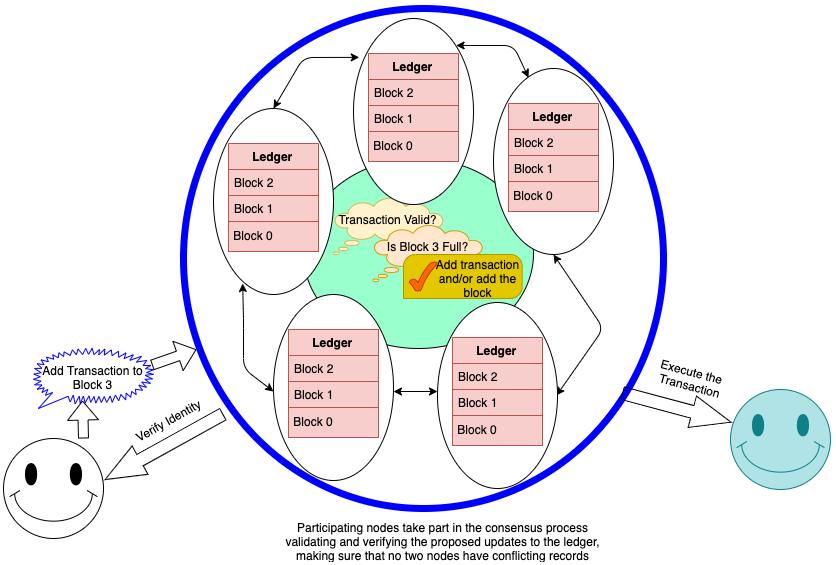
In the last chapter, we deployed our first multi-node network and talked a bit about consensus algorithms. We saw how nodes stay in sync over the data that has been put on the blockchain. And then we learned how to deploy a contract on to this network and how to send transactions to a deployed contract. However, we never really explained what a transaction is. We simply used it. In this chapter, we’ll get a better understanding of all they do and highlight their uses in DLT frameworks. While we are at it, we will look at the visibility of data in a DLT network to see what information transactions leak.
(web3.eth.getAccounts((err, acc) => { Dealer.options.from = acc[0]; }));
Dealer.options.gas = 5000000; // default gas limit for transactions