concept event - source system in category c#

This is an excerpt from Manning's book Functional Programming in C#: How to write better C# code.
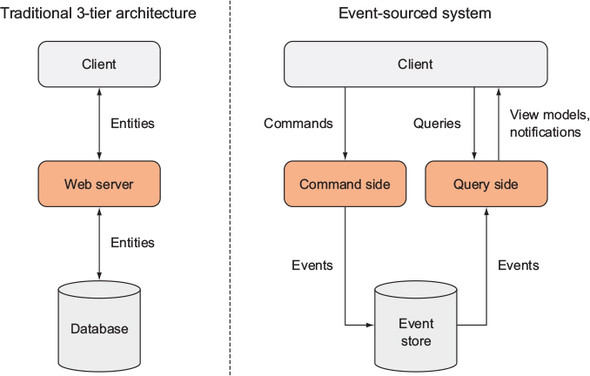
The data flows in an event-sourced system are different from those in a traditional system, where data is backed up by a relational store. As figure 10.5 shows, in CRUD-oriented systems the program deals in entities, or, better, in states. States are saved in the DB, states are retrieved by the server, and states are sent to the client. The transformations between the “model” (the data stored in the DB) and the “view model” (the data sent to the client) are often very minor.
In an event-sourced system, things are quite different. What we persist is events. But users won’t want to see an event log, so the data that we surface for the users’ consumption must be structured in a meaningful way. For this reason, an event-sourced system can be split neatly into two separate parts: