concept version in category c#

This is an excerpt from Manning's book ASP.NET 4.0 in Practice.
You can now activate ViewState on a per-control basis. This feature gives you both flexibility and some control over the ViewState size. In previous versions of ASP.NET, you could specify this behavior only for parent controls. If you had a child control inside a parent whose ViewState was off, the child controls inherited this behavior. In version 4.0, you can tweak this property and disable ViewState for the parent and enable it for a particular child control. You can do the same thing to Page, too, because it’s a special control (the root one). You’ll learn more about this topic in chapter 11.
Version 4.0 introduces a new set of devices previously not supported, such as Google’s Chrome, RIM’s BlackBerry, and Apple’s iPhone. Major browsers like Internet Explorer, FireFox, Opera, and Safari (for different platforms, where available) are already supported.

This is an excerpt from Manning's book DSLs in Boo: Domain-Specific Languages in .NET.
And that’s it—all the building blocks that you need to write a good DSL. We’re going to spend a lot more time discussing all the things we can do with DSLs, how we can integrate them into real applications, and version, test, and deploy them, but you should now have an overall understanding of what’s involved.
One way of handling versioning is to ensure backward compatibility within a major version of the software, but not guaranteeing backward compatibility between major versions. For example, if you have version 1.0, revisions 1.1, 1.5, and 1.8 are all backward compatible. But version 2.0 isn’t necessarily backward compatible with the 1.x versions.
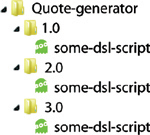
Another approach is to encode the version using a folder-hierarchy convention:
At the same time, you don’t need to care about the versioning of anything new that you create until you reach the next boundary. None of the changes you make from versions 1.0 to 2.0 have versioning implications until you’ve released 2.0. This is important when it comes to considering the regression suite. You shouldn’t include tests there for new features—not until they have been released and instantly become regression tests that you must never break or change.