concept container in category camel

This is an excerpt from Manning's book Camel in Action.
We should also mention what Camel isn’t. Camel isn’t an enterprise service bus (ESB), although some call Camel a lightweight ESB because of its support for routing, transformation, orchestration, monitoring, and so forth. Camel doesn’t have a container or a reliable message bus, but it can be deployed in one, such as the previously mentioned Apache ServiceMix. For that reason, we prefer to call Camel an integration framework rather than an ESB.
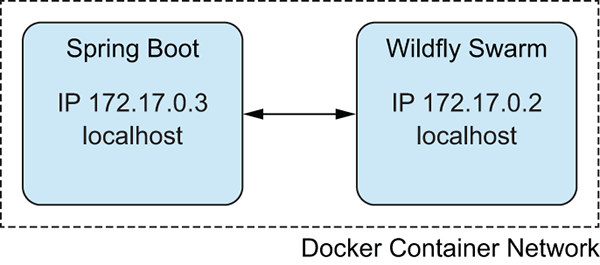
Figure 18.2 Each Docker container is isolated and has its own unique assigned IP address. The applications running inside the containers can’t communicate with each other using localhost, but must use the IP address instead.
When the WildFly Swarm container is started, Kubernetes will wait 10 seconds before performing periodic readiness checks. If the container reports it’s ready, it’s added to the list of active endpoints on the service. But if anytime later the readiness check fails, the container is removed from the active endpoints and will no longer receive requests. If the container becomes active again, it will be re-added as an active service endpoint.
A liveness check is also periodically triggered by Kubernetes (both checks will keep running). If a liveness probe fails, Kubernetes will assume that the container is unhealthy and restart the container, or if deemed necessary re-create the pod.