concept system in category camel

This is an excerpt from Manning's book Camel in Action.
Building complex systems from scratch is a costly endeavor, and one that’s almost never successful. An effective and less risky alternative is to assemble a system like a jigsaw puzzle from existing, proven components. We depend daily on a multitude of such integrated systems, making possible everything from phone communications, financial transactions, and health care to travel planning and entertainment.
You can’t finalize a jigsaw puzzle until you have a complete set of pieces that plug into each other simply, seamlessly, and robustly. That holds true for system integration projects as well. But whereas jigsaw puzzle pieces are made to plug into each other, the systems we integrate rarely are. Integration frameworks aim to fill this gap. As a developer, you’re less concerned about how the system you integrate works and more focused on how to interoperate with it from the outside. A good integration framework provides simple, manageable abstractions for the complex systems you’re integrating and the “glue” for plugging them together seamlessly.
Figure 1.11 An endpoint acts as a neutral interface allowing systems to integrate.
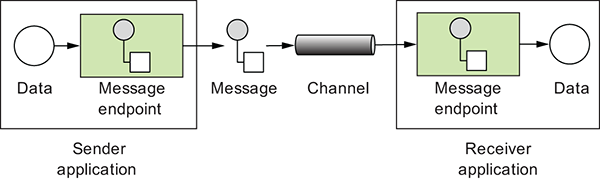
Integrated systems are notoriously difficult to test. Systems being built and integrated today often involve a myriad of systems ranging from legacy systems, closed source commercial products, homegrown applications, and so on. These systems often have no built-in support for automated testing.
The poor folks who are tasked with testing such integrated systems often have no other choice than to play through manual use cases—triggering events from one window/terminal and then crossing their fingers and watching the results in the affected systems. And by watching, we mean looking at log files, checking databases, or any other manual procedure to verify the results. When they move on to the next use case, they have to reset the system to ensure its correct state before carrying on with the testing.
During development, the systems being integrated are often test systems that are from other teams or are available only in production. If the systems aren’t network connected, internal company procedures may hold back a speedy resolution. With the higher number of systems involved, it becomes more difficult for developers to build and test their work.