concept churn rate in category churn

This is an excerpt from Manning's book Fighting Churn with Data.
All of these new digital services are generating vast amounts of data, resulting in a huge signal to noise challenge, which is why this book is so important. I study this topic for a living, and no one has written such a practical and authoritative guide to effectively filtering through all that information in order to reduce churn and keep subscribers happy. When it comes to running a subscription business, churn rates are matter of life and death!
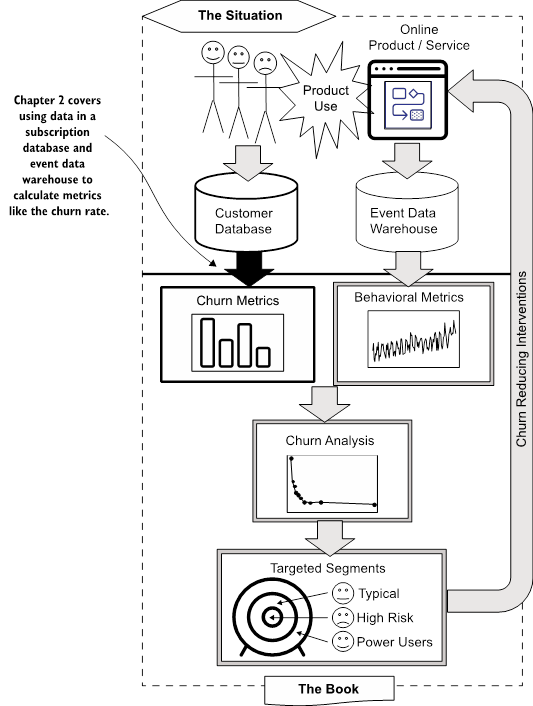
You have already learned that the churn rate is a measurement of the proportion of customers who quit every month or year. If you don't measure churn correctly, it's that much harder to do anything about it. This chapter teaches you multiple definitions of churn that are suitable for different business scenarios and how to calculate them efficiently from a subscription database. Recalling the overall book scenario introduced in chapter 1, this chapter focuses on the process highlighted in figure 2.1.
Figure 2.1 The subjects of this chapter in the process of fighting churn with data
Calculating the churn rate really is not rocket science, but you do need to know some intermediate SQL and a couple of algebraic equations. There are a few things that make calculating churn rates nontrivial. Part of the challenge is complexity, and another is logistical. The complexity in calculating churn is that an account can have multiple subscriptions over its lifetime, including: