concept time period in category churn

This is an excerpt from Manning's book Fighting Churn with Data.
Like all churn measures, net retention ignores new revenue acquired from signups during the time period. On the other hand, an important fact about net retention is that it includes changes in revenue from subscribers who are retained if this occurs. This can occur for any product or service with multiple product plans, temporary discounts, or pricing plan changes (most paid subscriptions). I will ignore these details and focus on teaching the calculation of net retention and churn; you will learn about these different cases in the following sections.
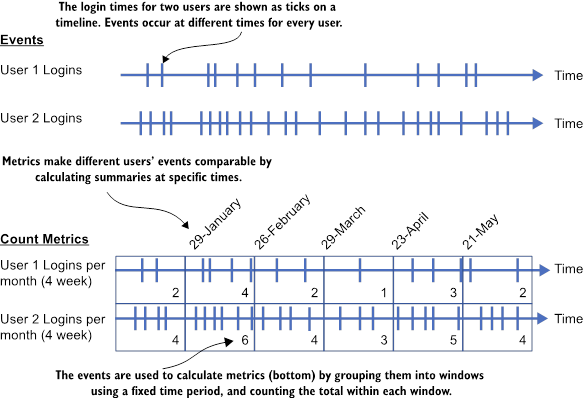
In this section, I first introduce the concept of turning events into metrics without any code, and then I show you the SQL. Imagine you are collecting login events in your data warehouse, and you want to turn them into usable information. For each user, you have a series of events, as illustrated in the top half of figure 3.2. To start, we focus on only the series for a single event: logins. In typical online product scenarios, there are many types of events, and the events can occur at any time. For some types of events, there can even be multiple events at the same time. To find subscribers’ comparable metrics, use a time period to make the measurements, as illustrated in the bottom half of figure 3.2.
Figure 3.2 Events transformed into time-windowed metrics.
A time period in this context means a range of time (a start time and an end time) in which to measure data. But these periods are defined relative to the observation time of each measurement, so a time period is usually described by its duration or length.