concept clojure in category clojure

This is an excerpt from Manning's book Clojure: The Essential Reference.
The short answer is: they don’t need to be. Also consider that a language specification doesn’t always mandate the content of the additional language utilities and tools. The standard library is then free to be described and documented in a less formal way. Clojure doesn’t have a formal language specification, let alone a standard library specification. Clojure’s informal (and pragmatic) approach is also its main weakness in terms of documentation: the language and the standard library are described in a very essential style which is often considered beginner-unfriendly [3]. A lot of effort has been put lately into improving Clojure documentation although, at the time of this writing, the standard library is still lacking a comprehensive and centralized reference.
(def matchers     ; #1
  {"next generation" 10
   "incredible" 10
   "revolution" 10
   "you love" 9
   "more robust" 9
   "additional benefits" 8
   "evolve over time" 8
   "brings" 7
   "perfect" 5
   "better solution" 7
   "now with" 6})

(defn avg-xf [rf] ; #2
  (let [cnt (volatile! 0)]
    (fn
      ([] (rf))
      ([result]
       (rf (if (zero? @cnt)
             0.
             (float (/ result @cnt)))))
      ([result input]
       (vswap! cnt inc)
       (rf result input)))))

(defn score [text] ; #3
  (transduce
    (comp
      (map #(re-find (re-pattern %) text))
      (keep #(matchers %))
      avg-xf)
    + (keys matchers))) ; #4

(score
  "All-new XT600 brings all the features        ; #5
   you love about XT300, now with a new design,
   improved sound and a lower price!")
;; 7.3333335

(score                                          ; #6
  "We think this book is a perfect fit for the intermediate
   or seasoned Clojure programmer who wants to understand
  how a function (and ultimately Clojure) works")
;; 5.0

This is an excerpt from Manning's book Get Programming with Clojure.
Clojure is a LISP dialect. Lisp is a family of computer programming languages with a long history and a distinctive, fully parenthesized prefix notation
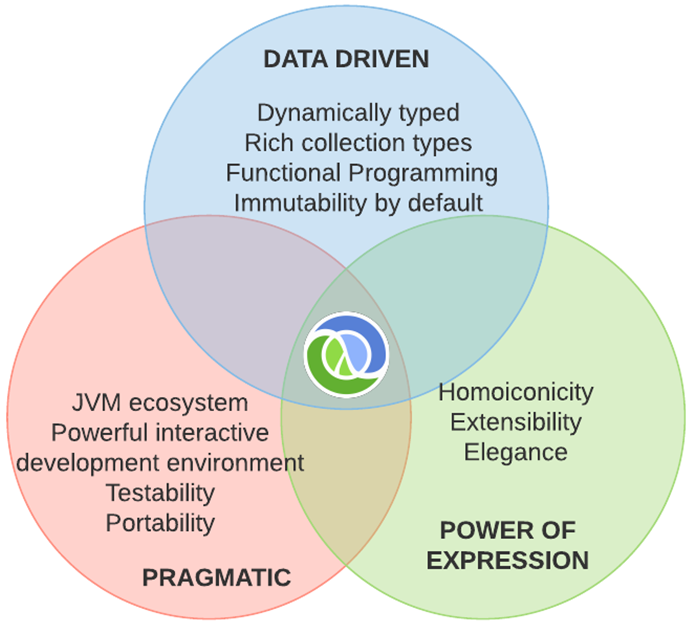
Figure 2.1 Clojure key features can be grouped into three main themes: Pragmatism, Data driven and Power of expression. Clojure logo in the middle area of this Venn diagram symbolizes the fact that Clojure integrate those 3 themes: Clojure is a pragmatic, data-driven language that offers high power of expression to its developers.
user=> (str "Clojure " "rocks!")
 "Clojure rocks!"
 user=> (str "Clojure " "is " "awesome.")
 "Clojure is awesome."

This is an excerpt from Manning's book Clojure in Action, Second Edition.
(str "Hello from " "Clojure with " "lots of " " arguments")
;; Result: "Hello from Clojure with lots of arguments"
If you talk to seasoned Lisp or Clojure programmers, you’ll find that opinion about the use of macros varies a great deal. Some say that macros are almost too powerful and that they should be used with great caution. I’ve always thought that any feature of a programming language can be misused when it isn’t fully understood. Further, the advantages of using macros far outweigh the perceived disadvantages. After all, the whole point of Clojure being homoiconic is to make the macro system possible.

This is an excerpt from Manning's book The Joy of Clojure, Second Edition.

Listing 15.11. Reimplementing Clojure’s range function using lazy-seq
(defn empty-range? [start end step] (or (and (pos? step) (>= start end)) (and (neg? step) (<= start end)))) (defn lazy-range [i end step] (lazy-seq (if (empty-range? i end step) #1 nil #2 (cons i (lazy-range (+ i step) end #3 step))))) #1 – Termination case #2 – nil terminates lazy seq #3 – Construct first and rest values !@%STYLE%@! {"css":"{\"css\": \"font-weight: bold;\"}","target":"[]"} !@%STYLE%@!
Thank you for taking the time to read this book; we hope it was as much a pleasure to read as it was for us to write. Likewise, we hope you’ll continue your journey with Clojure. Should you choose to diverge from this path, then we hope some of what you’ve learned has helped you to view the art of programming in a new light. Clojure is an opinionated language, but it and most of its community believe these opinions can work to enhance the overall state of affairs in our software industry. The onus is on us to make our software robust, performant, and extensible. We believe the path toward these goals lies with Clojure.
Clojure’s add-watch and remove-watch functions provide the underpinnings of an observer (publisher/subscriber) capability based on reference types. You can see this through the implementation of the simple defformula macro shown in the following listing.