concept conj in category clojure

This is an excerpt from Manning's book Clojure: The Essential Reference.
(loop [i 0 s []]
  (if (< i 10)
    (recur (inc i) (conj s (* i i)))
    s))
;; [0 1 4 9 16 25 36 49 64 81]
(import 'clojure.lang.PersistentQueue)

(def xform  ; #1
  (comp
    (map dec)
    (drop-while neg?)
    (filter even?)))

(defn queue [& items] ; #2
  (reduce conj (PersistentQueue/EMPTY) items))

(defn maintain ; #3
  ([fx f coll]
    (into (empty coll) (fx f coll)))
  ([xform coll]
    (into (empty coll) xform coll)))

(def input-queue
  (queue -10 -9 -8 -5 -2 0 1 3 4 6 8 9))

(def transformed-queue  ; #4
  (maintain xform input-queue))

(peek transformed-queue) ; #5
;; 0

(into [] transformed-queue) ; #6
;; [0 2 8]
conjdelegates the input collection to find the best way to insert a new element.conjimplementation for maps and sets (ordered or not) is a very different operation than the one for sequential collections (vectors, lists, ranges and so on), where the item can simply be appended without worrying about the existing content.The following chart shows a comparison between maps and sets (ordered or unordered).
conjhas been used in all cases to add a non-existent keys into an increasingly bigger data structure (up to 1 million keys). For sorted collections, the new key has been selected to be roughly in the middle (using integer types) of the existing keys.Figure 8.3. Efficiency of
conjfor sets and maps, ordered and unordered.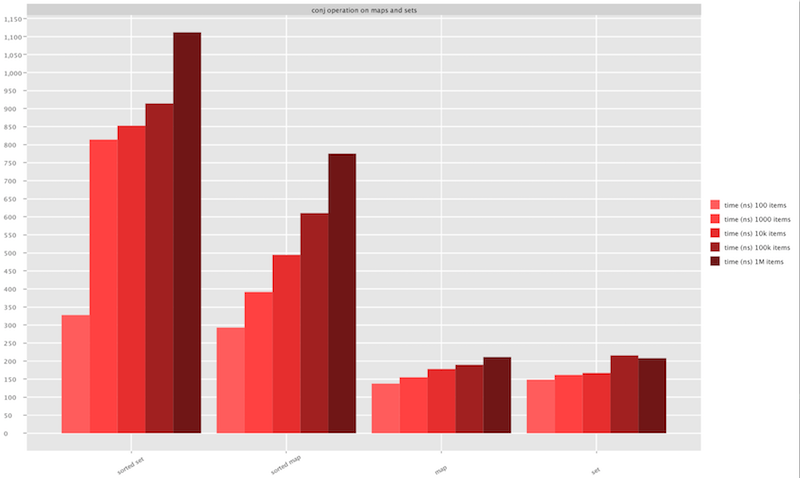
conjisO(log N)for sorted maps and sorted sets. This is remarkable feature for an ordered collection.conjon unsorted maps (or sets) is instead nearO(1)constant time (more preciselyO(log 32 N)which is irrelevant in most practical cases).The next chart repeats similar benchmark on some of the most used sequential types. As expected,
conjperforms faster on these types because there is no need to check on the existence of the element, or to prepare space for the new key-pair in a specific place in the underlying data structure.Figure 8.4. Efficiency of
conjfor sequential data structures.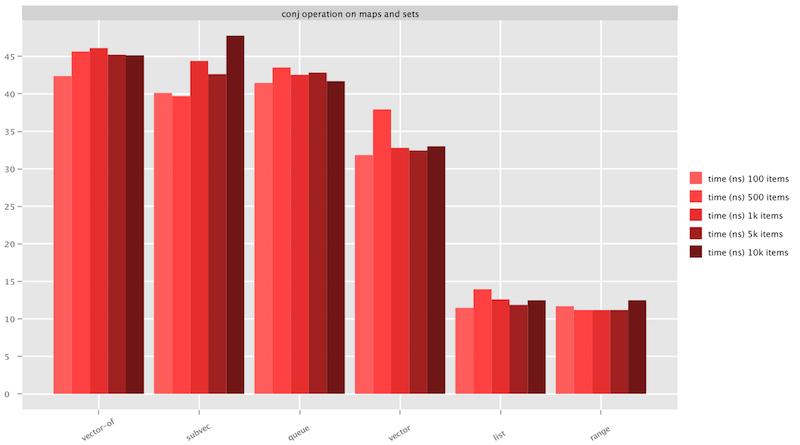
The very fast results on lists and ranges is primarily because
conjjust creates a cons-cell, a small object that is linked to the rest of the collection. The reader should also keep in mind thatconjis not designed for bulk-inserts of many elements (for which other functions like “into” are better suited).