concept error in category clojure
appears as: errors, error, n error, Error

This is an excerpt from Manning's book The Joy of Clojure, Second Edition.
Even if you manage to ensure that your BigDecimal values are free from floating-point corruption, you can never protect them from themselves. At some point, a floating-point calculation will encounter a number such as 2/3 that always requires rounding, leading to subtle yet propagating errors. Finally, floating-point arithmetic is neither associative nor distributive, which may lead to the shocking result that many floating-point calculations are dependent on the order in which they’re carried out:
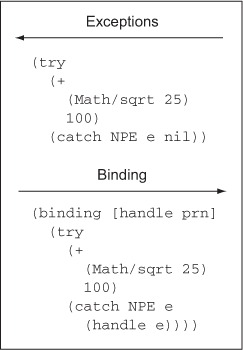
Figure 12.9. There are two ways to handle errors in Clojure. The typical way is to let exceptions flow from the inner forms to the outer. The other way, discussed in section 17.4, uses dynamic bindings to reach into the inner forms to handle errors immediately.
Listing 13.2. Extending IFn to LinkedMap
(.set m 43 :odd) #1 (m 43) #2 ;; "Error evaluating:" (m 43) :as "cljs.user.m.call(null,43)" (extend-type goog.structs.LinkedMap cljs.core/IFn (-invoke #3 ([m k] (.get m k nil)) ([m k not-found] (.get m k not-found)))) (m 43) #4 ;=> :odd #1 – Add another entry to the LinkedMap #2 – Calling a LinkedMap as a fn doesn’t work yet #3 – Define invoke for LinkedMaps #4 – Calling m now works !@%STYLE%@! {"css":"{\"css\": \"font-weight: bold;\"}","target":"[]"} !@%STYLE%@!