concept nothing in category clojure
appears as: nothing

This is an excerpt from Manning's book The Joy of Clojure, Second Edition.
The evaluation of another kind of collection, a vector, starts again by evaluating the items it contains. Because they’re literal scalars, nothing much happens. Once that’s done, evaluation of the vector can proceed. Vectors, like scalars and maps, evaluate to themselves:
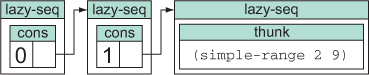
Figure 6.2. Each step of a lazy seq may be in one of two states. If the step is unrealized, it contains a function or closure of no arguments that can be called later to realize the step. When this happens, the thunk’s return value is cached instead, and the thunk itself is released as pictured in the first two lazy seq boxes, transitioning the step to the realized state. Note that although not shown here, a realized lazy seq may contain nothing at all, called nil, indicating the end of the seq.
Listing 12.10. DynaFrame class ns block showing rich gen-class usage
(ns joy.gui.DynaFrame (:gen-class :name joy.gui.DynaFrame :extends javax.swing.JFrame #1 :implements [clojure.lang.IMeta] #2 :prefix df- :state state #3 :init init #4 :constructors {[String] [String] #5 [] [String]} :methods [[display [java.awt.Container] void] #6 ^{:static true} [version [] String]]) #7 (:import (javax.swing JFrame JPanel JComponent) (java.awt BorderLayout Container))) #1 - :extends flag names the superclass that this namespace extends. Java allows only one superclass. #2 - :implements flag names a vector of interfaces that this namespace implements. Java allows a class to implement the methods of any number of interfaces, but here you only implement one. #3 - Instances can hold some state, and the :state flag names the var that holds the state data. #4 - :init flag names an initializer function that’s called after an instance of the class that this namespace implements is instantiated. #5 - :constructors flag expects a mapping of the class constructors to the superclass constructors. You define a mapping for two constructors: one takes a String type and delegates to the constructor for javax.swing.JFrame, which also takes a String; the other takes no arguments and also maps to the superclass String constructor. #6 - :methods flag names the public methods that will be available on the joy.gui.DynaFrame class implemented by this namespace. display takes a java.awt.Container object and returns nothing. #7 - version takes nothing and returns a String object. ^{:static true} on the vector describing version indicates that the method is static or available on the class itself rather than its instances. !@%STYLE%@! {"css":"{\"css\": \"font-weight: bold;\"}","target":"[]"} !@%STYLE%@!