concept parallel in category clojure

This is an excerpt from Manning's book Clojure: The Essential Reference.
comp has some similarities with juxtin that they both compose multiple functions into one, but they are different in the way the functions are composed to obtain the final result, for example:((comp f g h) x)is equivalent to(f (g (h x)))while((juxt f g h) x)is equivalent to[(f x) (g x) (h x)]. Use comp instead ofjuxtwhen the goal is for each function output to be the input for the next function. Usejuxtwhen functions should operate in parallel on the same input.
In its simplest form,
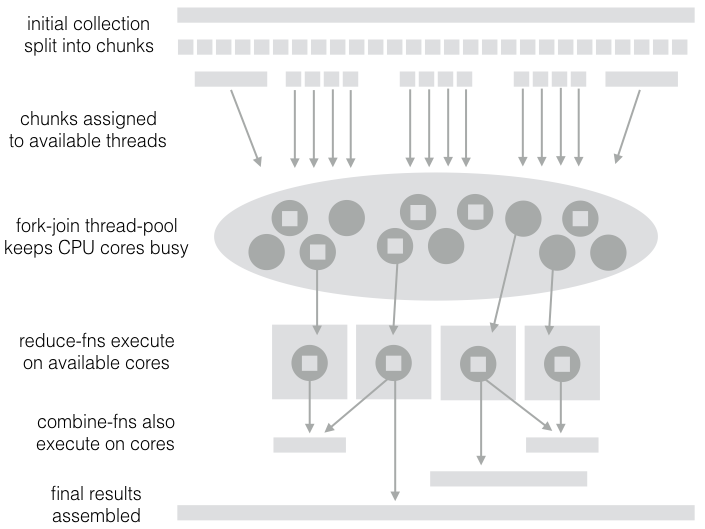
foldtakes a reducing function (a function supporting at least 2 arguments) and a collection. If the input collection supports parallel folding (currently vectors, maps and foldcat objects), it splits the input collection into chunks of roughly the same size and executes the reducing function on each partition in parallel (and on multiple CPU cores when possible). It then combines the results back into a single output:(require '[clojure.core.reducers :as r]) ; #1 (r/fold + (into [] (range 1000000))) ; #2 ;; 499999500000
foldoffers parallelism based on "divide and conquer": chunks of work are created and computation happens in parallel while, at the same time, finished tasks are combined back into the final result. The following diagram illustrates the journey of a collection going through a fold operation:Figure 7.1. How the fork-join model to reduce-combine in parallel.

This is an excerpt from Manning's book The Joy of Clojure, Second Edition.
Listing 11.7. Counting text occurrences in feed titles fetched in parallel
(defn occurrences [extractor tag & feeds] (as-futures [feed feeds] (count-text-task extractor tag feed) :as results => (reduce + (map deref results)))) #1 #1 - Sum all counts stored in the futures !@%STYLE%@! {"css":"{\"css\": \"font-weight: bold;\"}","target":"[[{\"line\":7,\"ch\":0},{\"line\":7,\"ch\":41}]]"} !@%STYLE%@!
Finally, Clojure provides a pcalls function that takes an arbitrary number of functions taking no arguments and calls them in parallel, returning a lazy sequence of the results. Its use shouldn’t be a surprise by now:
You’ve now seen the simplicity of the reducibles interface and how it can improve performance while providing syntax nearly identical to Clojure’s seq library. By using protocols, you can even use some of the same functions and collections you already know, like reduce and vectors. But it’s possible to get results even faster by giving up more guarantees. If you don’t care about the order in which your reducing functions are called, several of them can be run in parallel.