concept println in category clojure

This is an excerpt from Manning's book Clojure: The Essential Reference.
Listing 2.2. custom-metadata-annotations
(ns profilable)

(defn ^:bench profile-me [ms] ; #1
  (println "Crunching bits for" ms "ms")
  (Thread/sleep ms))

(defn dont-profile-me [ms]
  (println "not expecting profiling"))

(ns user)

(defn- wrap [f]
  (fn [& args]
    (time (apply f args))))

(defn- make-profilable [v]
  (alter-var-root v (constantly (wrap @v))))

(defn- tagged-by [tag nsname]
  (->> (ns-publics nsname)
       vals
       (filter #(get (meta %) tag))))

(defn prepare-bench [nsname] ; #2
  (->> (tagged-by :bench nsname)
       (map make-profilable)
       dorun))

(profilable/profile-me 500) ; #3
;; Crunching bits for 500 ms

(prepare-bench 'profilable)

(profilable/profile-me 500) ; #4
;; Crunching bits for 500 ms
;; "Elapsed time: 502.422309 msecs"

(profilable/dont-profile-me 0) ; #5
;; not expecting profiling
format,printfandcl-formatare functions dedicated to string formatting.formatis a wrapper around Java’sString::formatmethod, which is inspired by the venerableprintffunction from the C language. In Clojureprintfis a small function wrapping println withformat.

This is an excerpt from Manning's book Get Programming with Clojure.
In order to print to the console in Clojure, we use mostly the println functions. It works in a similar way to the printing functions that your are familiar with from other programming languages, but they are some subtle differences that we will detail in this Lesson.
println receive any number of arguments and print them to the console with a whitespace character between them and a new line character at the end of the output (println stands for “print line”). Here are some examples of print expressions:
(println "Hello")
 (println "How " "are " "you?")
 (println "I am " 42 " years old.")
Let’s first explore how println behaves when the arguments are all strings. Later on this section, we will deal with non-strings arguments.
When we call println in the REPL, we see both the output produced by the function and nil at the end of the output, which probably looks weird to you:
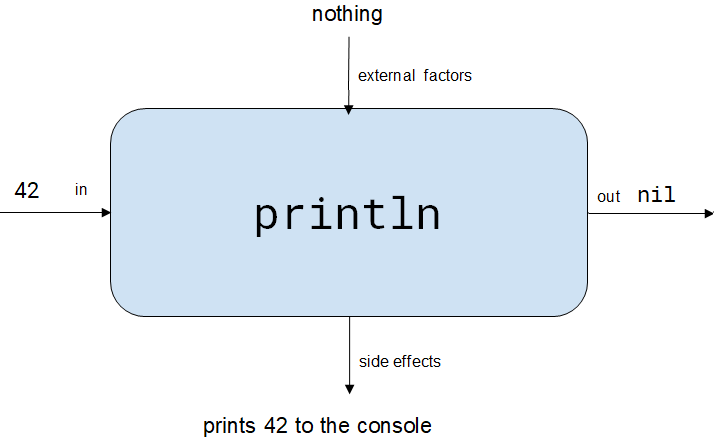
The first line is the output of println (the side effects), while the second line is the return value of println (return value).
KEY POINT
When an expression is evaluated in the REPL, the REPL, displays the output of the expression (side effects) and the return value of the expression.
Let’s take some time to clarify it further by drawing a flow diagram (Fig 16.1) for a println expression.
Fig 16.1 - Flow diagram for println receiving 42 as an input
KEY POINT
The distinction between side effects and return value is a key idea of functional programming.
Another way to clarify the distinction between side effects and return value is to assign the result of a println expression into a variable and to look at the value of the variable:
user=> (def my-var (println "hello"))
 hello
 nil
The value of my-var is the value returned by (println "hello"), which is nil. Therefore, when we evaluate my-var in the REPL we see nil:
user=> my-var
 nil
In my opinion, println is a boring function in a sense that its return value is always nil. Let’s make our own println function that is a bit more interesting. Our function will not only print to the console but also returns a value that is not nil. We call it println-and-return: it receives a single argument, displays it to the console and returns it. Here is the code for println-and-return:
user=> (defn println-and-return [x]
   #_=>   (println x)      #A
   #_=>   x)               #B
 Created function println-and-return ([x])