concept specification in category clojure

This is an excerpt from Manning's book The Joy of Clojure, Second Edition.
Laziness isn’t limited to the case of the evaluation of function arguments; a common example can be found even in eager programming languages. Take the case of Java’s logical-and operator &&. Java implementations, by dictate of the specification, optimize this particular operator to avoid performing unnecessary operations should an early subexpression evaluate to false. This lazy evaluation in Java allows the following idiom:
This specification says that for any two vectors, each containing two long integers, the slope function returns a floating-point number.[11] The machinery behind clojure .test.generative will generate millions of random long integers and run them all against slope to ensure that at no point does the specification fail. Of course, this isn’t a full specification of slope, but a full treatment of generative testing is outside the scope of this book.[12]
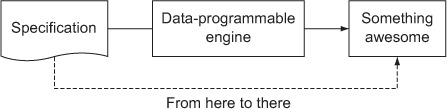
This approach certainly works if only a few functions define the extent of your conversion needs. But if your applications are like ours, then you probably need to convert to and from differing units of measure of many different magnitudes. You may need to convert back and forth between units of time, dimension, orientation, and a host of others. Therefore, it would be nice to be able to write a specification of unit conversions (Hoyte 2008) as a Clojure DSL and use its results as a low-level layer for high-layer application specifics. This is precisely the nature of Lisp development in general: each level in an application provides the primitive abstractions for the levels above it.
In this section, you’ll create a small specification and then convert it into a Clojure DSL using a technique that Rainer Joswig (Joswig 2005) called “putting parentheses around the specification.”
This specification is starting to look a little like Clojure code, but it would still be difficult to parse into a usable form. Likewise, it would be difficult for the person writing the specification to use the correct terms, avoid spelling mistakes, properly punctuate, and so on. This form is still not useful. It would be ideal if we could make this into a form that was recognizable to both Clojure and a conversion expert. Let’s try one more time:
(define unit of distance
  {:m 1,
   :km 1000,
   :cm 1/100,
   :mm [1/10 of a :cm],
   :ft 0.3048,
   :mile [is 5280 :ft]})
This almost looks like the units map from chapter 7, except for a few minor details. We’ll eventually zero in on a specification that matches the form expected by the convert function from chapter 7, but there is a more pressing matter at hand. That is, although you can use the convert function directly, it assumes a well-formed unit conversion map. This is problematic for use in a DSL because the details of covert will leak out to users in the form of nasty exceptions or errors. Instead, let’s create a driver function that checks input values and reports more sensible errors.