concept state in category clojure

This is an excerpt from Manning's book Clojure in Action, Second Edition.
Controlled, explicit changes to state
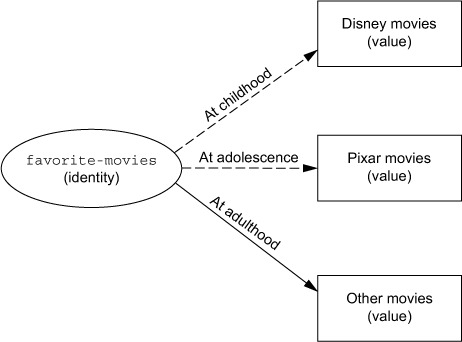
To summarize, it’s important to realize that we’re talking about two distinct concepts. The first is that of an identity—someone’s favorite movies. It’s the subject of all the action in the associated program. The second is the sequence of values that this identity assumes over the course of the program. These two ideas give us an interesting definition of state—the value of an identity at a particular point time. This separation is shown in figure 6.1.
Figure 6.1. It’s important to recognize the separation between what we’re talking about (say, favorite movies, which is an identity) and the values of that identity. The identity itself never changes, but it refers to different values over time.
This idea of state is different from what traditional implementations of OO languages provide out of the box. For example, in a language like Java or Ruby, the minute a class is defined with stateful fields and destructive methods (those that change a part of the object), concurrency issues begin to creep into the world and can lead to many of the problems discussed earlier. This approach to state might have worked a few years ago when everything was single threaded, but it doesn’t work anymore.
Now that you understand some of the terms involved, let’s further examine the idea of using a series of immutable values to model the state of an identity.
State is the current set of values associated with things in a program. For example, a payroll program might deal with employee objects. Each employee object represents the state of the employee, and every program usually has a lot of such state. There’s no problem with state, per se, or even with mutating state. The real world is full of perceived changes: people change, plans change, the weather changes, and the balance in a bank account changes. The problem occurs when concurrent (multithreaded) programs share this sort of state among different threads and then attempt to make updates to it. When the illusion of single-threaded execution breaks down, the code encounters all manner of inconsistent data. In this section, we’ll look at a solution to this problem. But before we do, let’s recap the issues faced by concurrent programs operating on shared data.

This is an excerpt from Manning's book The Joy of Clojure, Second Edition.
Figure 1.7. The Runner. A child’s flip book serves to illustrate Clojure’s notions of state, time, and identity. The book itself represents the identity. Whenever you wish to show a change in the illustration, you draw another picture and add it to the end of your flip book. The act of flipping the pages therefore represents the states over time of the image within. Stopping at any given page and observing the particular picture represents the state of the Runner at that moment in time.
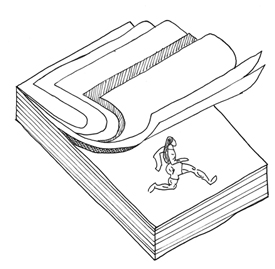
The first important term to define is time. Simply put, time refers to the relative moments when events occur. Over time, the properties associated with an entity—both static and changing, singular or composite—will form a concrescence (Whitehead 1929), or, in other words, its identity. It follows that at any given time, a snapshot can be taken of an entity’s properties, defining its state. This notion of state is an immutable one because it’s not defined as a mutation in the entity itself, but only as a manifestation of its properties at a given moment in time. Imagine a child’s flip book, as shown in figure 1.7, to understand the terms fully.
Figure 1.7. The Runner. A child’s flip book serves to illustrate Clojure’s notions of state, time, and identity. The book itself represents the identity. Whenever you wish to show a change in the illustration, you draw another picture and add it to the end of your flip book. The act of flipping the pages therefore represents the states over time of the image within. Stopping at any given page and observing the particular picture represents the state of the Runner at that moment in time.
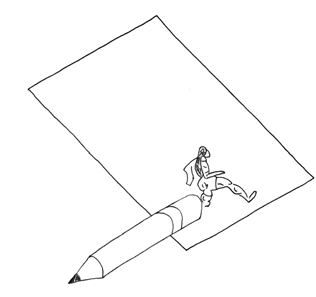
It’s important to note that in the canon of object-oriented programming (OOP), there’s no clear distinction between state and identity. In other words, these two ideas are conflated into what’s commonly referred to as mutable state. The classical object-oriented model allows unrestrained mutation of object properties without a willingness to preserve historical states. Clojure’s implementation attempts to draw a clear separation between an object’s state and identity as they relate to time. To state the difference from Clojure’s model in terms of the aforementioned flip book, the mutable state model is different, as shown in figure 1.8.
Figure 1.8. The Mutable Runner. Modeling state change with mutation requires that you stock up on erasers. Your book becomes a single page: in order to model changes, you must physically erase and redraw the parts of the picture requiring change. Using this model, you should see that mutation destroys all notion of time, and state and identity become one.
At the end of the events, the state of the player in question is exactly the same: five at-bats with two hits. But with event sourcing, it’s derived from the events themselves.
Next you need an effect function that takes a state and event and applies the event to the state in the proper way.
Listing 14.3. Event-sourcing function that affects state
(defn effect [{:keys [ab h] :or {ab 0, h 0}} #1 event] (let [ab (inc ab) h (if (= :hit (:result event)) #2 (inc h) h) avg (double (/ h ab))] {:ab ab :h h :avg avg})) #3 #1 - Set default fields if not present #2 - Handle a subset of possibilities #3 - Return the new state !@%STYLE%@! {"css":"{\"css\": \"font-weight: bold;\"}","target":"[]"} !@%STYLE%@!