concept case in category cloud

This is an excerpt from Manning's book Designing Cloud Data Platforms.
A second common use case for a data lake is IoT, where data from machines and sensors can be combined to create operational insights and efficiencies ranging from proactively predicting equipment failures on a factory floor or in the field, to monitoring skier (a person who moves over snow on skis) performance and location via RFID tags. The data from sensors tends to be very high volume and with a high degree of uncertainty, which makes it well-suited for a data lake. Traditional data warehouses don’t just struggle with this data: the sheer amount of data produced in an IoT use case makes a traditional data warehouse-based project extremely expensive and shifts the balance away from a good return on that investment for all but a small number of cases.
Let’s start with some definitions and use cases.

This is an excerpt from Manning's book Google Cloud Platform in Action.
Second, cloud hosting comes with the maintenance built in for several products. This means that cloud hosting results in minimal extra work to host your systems compared to other options where you might need to manage your own databases, operating systems, and even your own hardware (in the case of a colocated hosting provider). If you don’t want to (or can’t) manage these types of things, cloud hosting is a great choice.
When you make a request to App Engine, Google’s frontend servers handle the request and ultimately route it to a specific instance running your service. But App Engine keeps a queue of requests in case some of them aren’t ready to be handled yet. If no instance is available to respond to a given request immediately as it arrives, it can sit in a queue for a bit until an instance becomes available. Figure 11.14 shows an example of how you might think of the flow of a request through your App Engine service.
App Engine pricing is based on the hourly consumption of the underlying compute resources. In the case of App Engine Flex, the prices are identical to Compute Engine instance pricing.

This is an excerpt from Manning's book The Cloud at Your Service: The when, how, and why of enterprise cloud computing.
In a non-cloud world, you would have to build sufficient capacity to not only perform adequately under baseline load conditions, but also handle peak load scenarios with sufficiently good performance. In the case of a self-hosted model, this means over-provisioning the amount of hardware for a given allocation. In the case of a managed hosting deployment, you can start with a small set of resources and grow as the requirements of the application grow. But provisioning for a new set of dedicated hardware resources takes weeks or, in many larger organizations, months. Having thousands of virtualized resources that can be harnessed and released in correlation to application demand would be useless if such allocation and freeing required manual intervention.
Colocation services are typically purchased as annual contracts with an initial service fee and monthly charges based on the amount of rack space (usually bundled with a specified allocation of power) and committed bandwidth. For hardware housed in facilities that aren’t in close proximity to a company’s IT resources, you can purchase what some call “remote-hands” capability in case a manual intervention is required on your behalf.
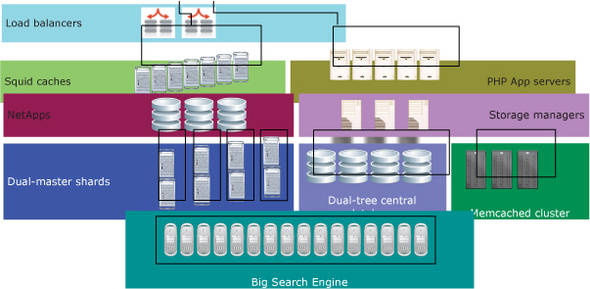
Figure 5.8. Flickr’s architecture includes many levels. First is load balancing as incoming connection requests arrive. Squid caches are open-source web-delivery systems that operate as reverse proxies for HTML pages and images. The PHP App Servers connect to the shards and keep the data consistent. The storage managers do the actual mapping from an index to the correct shard. NetApps are for mass storage of photos. Their fundamental database architecture uses dual masters for each shard. This gives them resilience in the case of failure. The dual-tree structure is a custom set of changes to MySQL that allows scaling by incrementally adding masters without a ring architecture. The central database includes data, such as the users table, which includes primary user keys (a few different IDs) and a pointer to which shard a user’s data can be found on. The Big Search Engine is a replication of the database Flickr wants to search.

This is an excerpt from Manning's book Azure in Action.
You can see how storage is logically represented in figure 1.12, but how does this translate into the world of Windows Azure? Your services won’t always be continually running on the same physical machine. Your roles (web or worker) could be shut down and moved to another machine at any time to handle faults or upgrades. In the case of web roles, the load balancer could be distributing requests to a pool of web servers, meaning that an incoming request could be performed on any machine.
You’ll need to give your credit card information so that they know who to bill for the time you use. Even if you have access to free time in the cloud through MSDN or some other channel, you’ll still need to provide a credit card number in case you go over your free allocation.