concept configuration file in category cloud

This is an excerpt from Manning's book Designing Cloud Data Platforms.
This configuration file is easy to read for humans and it also can be easily parsed by the actual pipeline code using any of the available YAML libraries for your language of choice. You can now see how all other pipeline metadata domains like Pipelines, Data Sources, etc. can be represented as configuration files.
A big benefit of this approach is that configuration files are just text files and in the end can be stored together with other code in your code repository. Your code versioning tool, such as git, mercurial, svn or any other, will also allow you to track all changes to these configuration files the same way you track changes to your code.
Figure 7.11. Storing configuration files in a database instead of text files on a cloud storage gives us an ability to run queries against these configurations
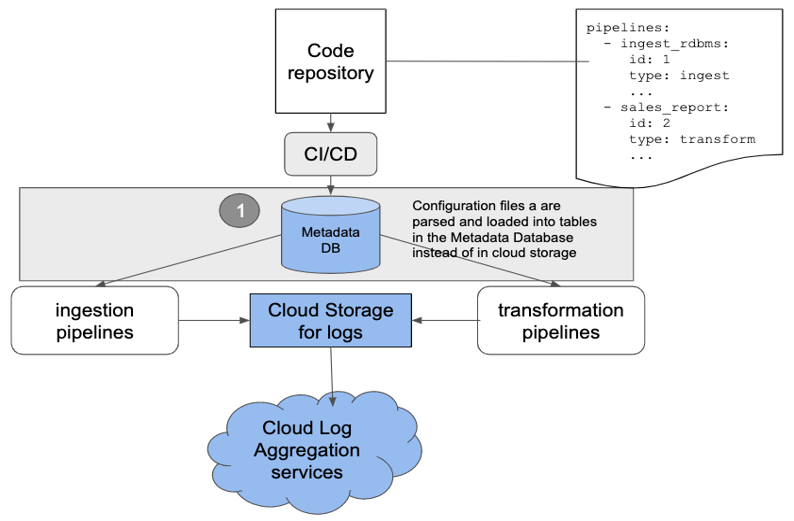
This metadata layer implementation looks very similar to the previous one except configuration files are not stored in the cloud storage, but are parsed and loaded into a database. This database can be either relational database or a document-oriented key/value store. The latter is often a better fit for configuration data, because the structure of your metadata will be evolving and it is easier to implement schema changes in a document data store than it is in a relational database. Each major cloud provider has fully managed services for relational databases and key/value stores. We have seen successful implementations of this approach using GCP Datastore, Azure CosmosDB and AWS DynamoDB.