concept organization in category cloud

This is an excerpt from Manning's book Designing Cloud Data Platforms.
In a traditional data warehouse, storage and processing are coupled together, significantly limiting scalability and flexibility. To accommodate a surge in data volume in traditional relational data warehouses, bigger servers with more disk, RAM and CPU to process the data must be purchased and installed. This approach is slow and very expensive, and because you can’t get storage without compute, buying more servers for more storage ensures you are paying for compute that you might not need, or vice versa. Network Attached Storage appliances evolved as a solution to this problem, but did not eliminate the challenges of easily and cost-effectively scaling compute. The bottom line is that in a traditional data warehouse design, processing large volumes of data is available only to organizations with significant IT budgets.
Addressing the business metadata management challenge is an array of tools designed to help organizations implement data tagging and data discovery. Alation, Collibra, Informatica are just some of the commercial metadata software products that specifically address these challenges. In addition, many of the ETL overlay tools, including Talend and Informatica, come with metadata management capabilities, often referred to as a Data Catalog. And of course, the public cloud providers also offer services in this space, some examples include Google Data Catalog, Azure Data Catalog, and AWS Glue Data Catalog which is part of Glue ETL service.

This is an excerpt from Manning's book The Cloud at Your Service: The when, how, and why of enterprise cloud computing.
In addition to the classifications we discussed earlier, we should introduce some important concepts relative to the different classifications of clouds. Private clouds are a variant of generic cloud computing where internal data-center resources of an enterprise or organization aren’t made available to the general public—that is, these pooled computing resources are actually not available to any subscribing users but are instead controlled by an organization for the benefit of other members of that organization. The public clouds of providers such as Amazon and Google were originally used as private clouds by those companies for other lines of business (book retailing and internet search, respectively).
If an organization has sufficient users and enough overall capacity, a private cloud implementation can behave much like a public cloud, albeit on a reduced scale. There has been a tremendous amount of capital investment in data-center resources over the past decade, and one of the important movements is the reorienting of these assets toward cloud-usage models.
Using the cloud already has security benefits. Centralizing data in the cloud as opposed to having it distributed all over the organization means less leakage because there’s less data on people’s laptops. When data is centralized, it’s easier to monitor access and usage. On the other hand, if there is a breach, having data centralized can mean a much more comprehensive and damaging data theft. With the number of data thefts of significant size and publicity at an all-time high, turning over the means to protect data to the cloud experts is still a much safer bet as thieves become more sophisticated.
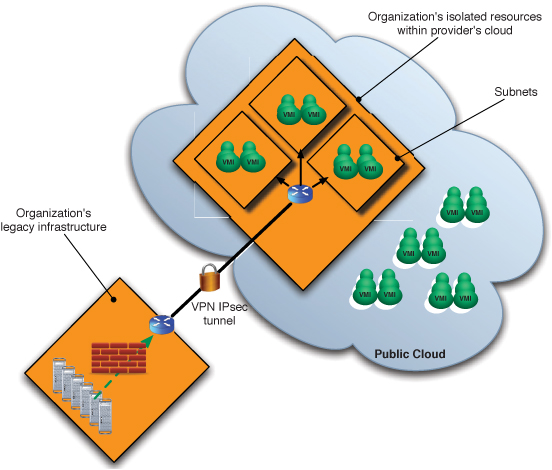
A VPC is a secure and seamless bridge between an organization’s existing IT infrastructure and a provider’s public cloud. You can see this in a high-level simplistic fashion in figure 4.9. The idea is to connect an organization’s existing infrastructure to a set of isolated cloud-compute resources via a VPN connection.
Figure 4.9. A high-level architectural view of a virtual private network. A secure VPN connection connects an organization’s existing infrastructure—including all its security components, such as firewalls and intrusion-detection systems—to a portion of the public cloud isolated for the organization.