concept place in category cloud

This is an excerpt from Manning's book Cloud Native Spring in Action.
Place. Cloud native applications run in modern, dynamic environments: the clouds (public, private, or hybrid).
There are a few ways to install Kubernetes on your local environment. The approach I recommend is installing minikube, a tool that runs a single-node Kubernetes cluster in a virtual machine on any operating system. That is what I’m going to use for the examples in this book. You can find the installation guide on the Kubernetes website: kubernetes.io. It requires a hypervisor to create the virtual machine to set up a Kubernetes cluster. The installation instructions give you a few options, but I recommend VirtualBox, which is compatible with Linux, macOS, and Windows. I’m using the latest Kubernetes version available at the moment: 1.19.

This is an excerpt from Manning's book Designing Cloud Data Platforms.
Variety - Hadoop’s ability to do schema on read (vs the data warehouse’s schema on write) meant that any file in any format could be immediately stored on the system, and processing could take place later. Unlike data warehouses, where processing could only be done on the structured data in the data warehouse, processing in Hadoop could be done on any data type.
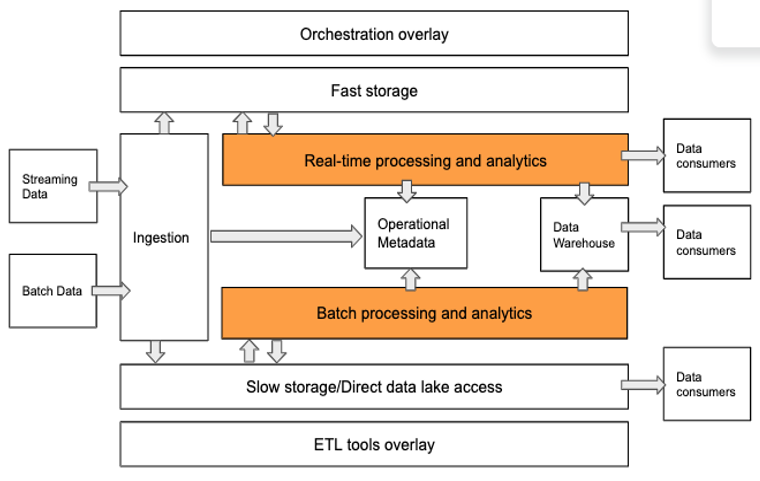
As we discussed in Chapter 3, the processing layer, highlighted in the diagram below, is the heart of the data platform implementation. This is where all the required business logic is applied and all the data validations and data transformations take place. The processing layer also plays an important role in providing ad-hoc access to the data in the data platform.
Figure 6.1. The processing layer is where business logic is applied and all data validations and data transformations take place as well as providing ad-hoc access to data