concept platform in category cloud

This is an excerpt from Manning's book Cloud Native Spring in Action.
The Function as a Service (FaaS) model leverages serverless computing to let consumers manage functions triggered by events. The cloud provider controls the rest of the stack. In this model, developers build individual functions rather than entire applications. The FaaS platform is then used to configure when such functions should be executed. For example, you might code a function that analyzes a data set whenever available from a message queue and computes results according to some algorithms. Examples of FaaS offerings are Amazon AWS Lambda, Microsoft Azure Functions, and Google Cloud Functions.

This is an excerpt from Manning's book Designing Cloud Data Platforms.
In all of our examples we will use platform-as-a-service (PaaS) offerings where possible. PaaS enables one of the most powerful promises of the cloud — getting platforms up and running in minutes, not days.
It causes too much duplicate data to be stored in the platform
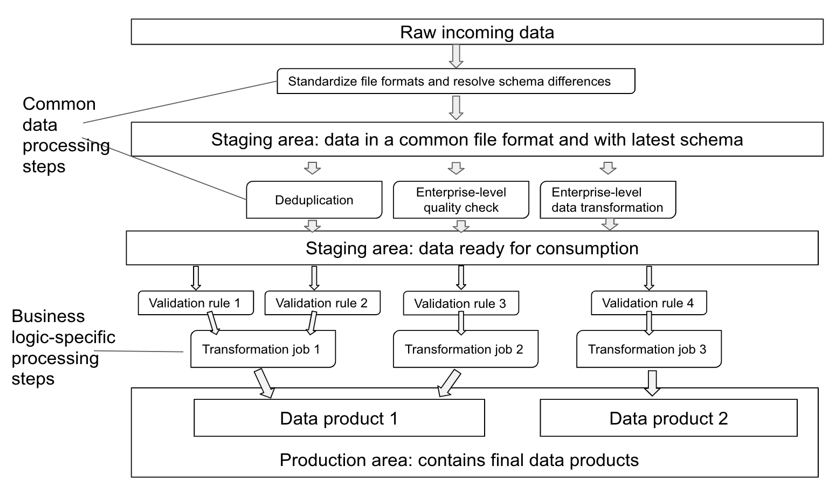
Figure 5.2 Data flows through different stages in the platform with processing applied at different steps
This is an excerpt from Manning's book Cloud Native Patterns: Designing change-tolerant software.
Although the platform your applications run on provide some of the necessary support for safe deployments (and I’ll talk more about this in chapter 3), all four of these factors—versioning, metrics, routing, and componentization—are things that you, as a developer, must consider when you design and build your cloud-native application. There’s more to cloud-native software than these things (for example, designing bulkheads into your architecture to keep failures from cascading through the entire system), but these are some of the key enablers of safe deployments.
Figure 3.8. The state of applications running on the platform is managed by continually comparing the desired state to the actual state and then executing corrective actions when necessary.
![]()
The complexity lies in the distributed nature of the system. Frankly, distributed systems are hard. The algorithms implemented in the platform must account for lost messages from the API or hosts, network partitions that may be brief but disrupt the flow nonetheless, and flapping state changes that are sometimes due to such flaky networks. Components such as the state store must have ways of maintaining state when inputs to it are in conflict (Paxos and Raft protocols are two of the most widely used at the moment). Just as application teams needn’t concern themselves with the complexity of managing workloads across AZs, they also needn’t be burdened with implementation of eventually consistent systems; that capability is baked into the platform.
The platform is a complex distributed system, and it needs to be as resilient as distributed apps are. If the comparator goes down, either due to failure or even something planned such as an upgrade, the platform must be self-healing. The patterns I’ve described here for apps running on the platform are also used for the management of the platform. The desired state may include 100 hosts running application workloads and a five-node distributed state store. If the system topology differs from that, corrective actions will bring it back to the desired state.
But even more than ensuring that the runtime environments match, a platform must also provide contracts that allow deployed apps to absorb the differences that exist from one stage to the next. For example, environment variables, which are a ubiquitous way of supplying values needed by an app, must be served to the app the same way all through the SDLC. And the manner in which services are bound to apps, thereby supplying connection arguments, must also be uniform.
Figure 3.17 offers a visual depiction of this concept. The artifact deployed into each of the spaces is exactly the same. The contracts between the app and the environment config, and the app and services (in this case, the Loyalty Members database), are also uniform. Note that the arrows pointing from each of the deployable artifacts are exactly the same across all environments—what differs are the details behind the env config and loyalty members abstractions. Abstractions such as these are an essential part of a platform that’s designed to support the entire SDLC.
Figure 3.17. The platform must include a mechanism that allows the contract between app and runtime environment and bound services to serve the needs of the SDLC.
![]()
On occasion, I’ve had clients implement a platform only for preproduction environments or only for production. There’s no question that having a cloud-native platform that offers capabilities such as automated health management or a means of controlling standardized machine images provides value, even if available only in production. But given the need for continuous delivery of digital solutions, the platform must be applied across the entire SDLC. When the platform offers environment parity with the right abstractions, and an API that can be used to automate all interactions with it, the process of developing software and bringing it all the way through to production can be turned into a predictable, efficient machine.