concept private cloud in category cloud

This is an excerpt from Manning's book The Cloud at Your Service: The when, how, and why of enterprise cloud computing.
In addition to the classifications we discussed earlier, we should introduce some important concepts relative to the different classifications of clouds. Private clouds are a variant of generic cloud computing where internal data-center resources of an enterprise or organization aren’t made available to the general public—that is, these pooled computing resources are actually not available to any subscribing users but are instead controlled by an organization for the benefit of other members of that organization. The public clouds of providers such as Amazon and Google were originally used as private clouds by those companies for other lines of business (book retailing and internet search, respectively).
Private clouds (and virtual private clouds) are a hot topic in IT; a wide range of opinions exists about whether private clouds fit into today’s corporate IT strategy. Cloud computing technologies, in general, are evolving rapidly with private cloud computing in particular undergoing a rapid metamorphosis. A classic (and humorous) example is our research for this chapter. We spent a couple of days experimenting and putting together a private cloud implementation from open source. When we got around to writing the chapter several weeks later, we found that some folks had put together an even simpler procedure. What took us two days only a couple of weeks earlier could now be done in a matter of hours!
Some industry analysts, such as the Gartner Group, predict that private cloud spending will soon exceed public cloud spending. Consultancy McKinsey, on the other hand, goes as far as saying that there’s no such thing as a private cloud and that by focusing on virtualization, you can improve the efficiency of internal IT operations and increase the utilization of existing resources to the point where you can beat the economics of the public cloud. We disagree with this extreme view.
Security concerns and the economics of existing data centers are the two drivers toward private clouds. Both will eventually go away; the tenure of real (versus virtual) private clouds is temporary. Security is the hot-button du jour, so you need to know the facts about information security. If you aren’t familiar with the technical underpinnings of information security, please refer to this book’s appendix, which provides a review of the key concepts.[1]
Before you or anyone jumps to deploying a private cloud, let’s assess a quick set of four major concerns.
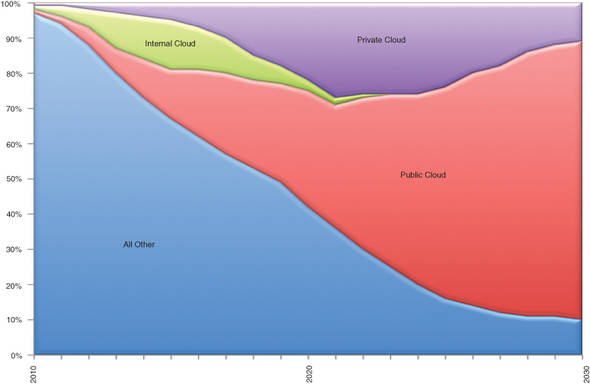
Figure 9.6. The author’s predictions for the role of clouds vs. non-cloud-based computing over the next 20 years. Today, less than 3% of computing is done via clouds. Twenty years from now, public clouds will be the dominant approach for corporate IT services. Private clouds, which will initially grow to more than 35% of all IT, will shrink back to under 25%; internal clouds will all but disappear; and the remaining percentage of do-it-yourself IT (such as corporations with their own data centers) will be only 10%.