concept production in category cloud

This is an excerpt from Manning's book Cloud Operations.
For humans is possibly even worse since people are more prone to errors can happen more frequently causing disastrous consequences. You probably have heard a story from a friend or colleague of someone they knew who managed to tear production down by mistake. That mistake is what least privilege prevents to happen.
This is an excerpt from Manning's book Cloud Native Patterns: Designing change-tolerant software.
Digital experiences are no longer a sidecar to our lives. They play a major part in many or most of the activities that we engage in on a daily basis. This ubiquity has pushed the boundaries of what we expect from the software we use: we want applications to be always available, be perpetually upgraded with new whizbang features, and provide personalized experiences. Fulfilling these expectations is something that must be addressed right from the beginning of the idea-to-production lifecycle. You, the developer, are one of the parties responsible for meeting those needs. Let’s have a look at some key requirements.
As a developer, you want nothing more than to create software that users will love and that will provide them value. When users want more, or you have an idea for something you’d like to bring to them, you’d like to build it and deliver it with ease. And you want your software to run well in production, to always be available and responsive.
Unfortunately, for most organizations, the process of getting software deployed in production is challenging. Processes designed to reduce risk and improve efficiency have the inadvertent effect of doing exactly the opposite, because they’re slow and cumbersome to use. And after the software is deployed, keeping it up and running is equally difficult. The resulting instability causes production-support personnel to be in a perpetual state of firefighting.
Listing 7.1. Utils.java
public class Utils implements
         ApplicationContextAware, ApplicationListener<ApplicationEvent> {

    // <lines omitted for brevity>
    @Value("${com.corneliadavis.cloudnative.posts.secrets}")
    private String configuredSecretsIn;
    private Set<String> configSecrets;

    // <lines omitted for brevity>

    @Override
    public void onApplicationEvent(ApplicationEvent applicationEvent) {

        if (applicationEvent instanceof ServletWebServerInitializedEvent) {
            ServletWebServerInitializedEvent
                servletWebServerInitializedEvent
                    = (ServletWebServerInitializedEvent) applicationEvent;
            this.port = servletWebServerInitializedEvent...
        } else if (applicationEvent instanceof ApplicationPreparedEvent) {
            configSecrets = new HashSet<>();
            String secrets[] = configuredSecretsIn.split(",");
            for (int i=0; i<secrets.length; i++)
                configSecrets.add(secrets[i].trim());
            logger.info(ipTag()
                         + "Posts Service initialized with secret(s): "
                         + configuredSecretsIn);
        }
    }

    public String ipTag() { return "[" + ip + ":" + port +"] "; }

    public boolean isValidSecret(String secret) {
        return configSecrets.contains(secret);
    }

    // The following method is included only to facilitate some
    // logging that wouldn't exist in production.
    public String validSecrets() {
        String result = "";
        for (String s : configSecrets)
            result += s + ",";
        return result;
    }
}


!@%STYLE%@!
{"css":"{\"css\": \"font-weight: bold;\"}","target":"[[{\"line\":18,\"ch\":15},{\"line\":18,\"ch\":74}],[{\"line\":19,\"ch\":12},{\"line\":19,\"ch\":44}],[{\"line\":20,\"ch\":12},{\"line\":20,\"ch\":62}],[{\"line\":21,\"ch\":12},{\"line\":21,\"ch\":48}],[{\"line\":22,\"ch\":16},{\"line\":22,\"ch\":53}],[{\"line\":23,\"ch\":12},{\"line\":23,\"ch\":31}],[{\"line\":24,\"ch\":25},{\"line\":24,\"ch\":71}],[{\"line\":25,\"ch\":25},{\"line\":25,\"ch\":48}],[{\"line\":31,\"ch\":4},{\"line\":31,\"ch\":49}],[{\"line\":32,\"ch\":8},{\"line\":32,\"ch\":46}]]"}
!@%STYLE%@!

This is an excerpt from Manning's book Google Cloud Platform in Action.
In this chapter, I’ll walk you through Cloud SQL in much more detail and cover more real-life situations. Entire books can be (and have been) written on various flavors of relational databases (such as MySQL or PostgreSQL), so if you decide to use Cloud SQL in production, a book on MySQL is a great investment. The goal of this chapter isn’t to duplicate any information you’d find in books like those, but to highlight the things that Cloud SQL does differently. It also highlights all the neat features that automate some of the administrative aspects of running your own relational database server.
Now that you’ve learned how to turn on a Cloud SQL instance, it’s time to go through what it takes to run Cloud SQL in a production-grade environment. Before I continue, it might be worthwhile to clarify that for the purposes of this chapter (and most of this book), when I say production I mean the environment that’s safe for you to run a business in. In a production environment, you’d have things like reliable backups, failover procedures, and proper security practices. Now let’s jump in by looking at one of the most obvious topics: access control.

This is an excerpt from Manning's book Azure in Action.
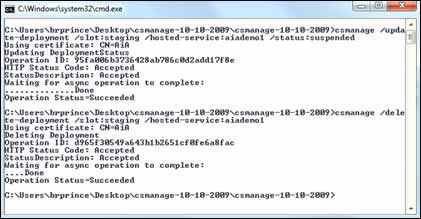
Summary— Lists your projects, and gives you access to managing them. From here you can upload new versions, flip staging and production, and manage log files.
Remember, when you move your application to production, you aren’t moving the application or the settings. When you flip the button, Azure reconfigures the fabric to route all new traffic from the outside world to this particular instance. The old production environment becomes the new staging environment. Because nothing actually moves, you can easily roll back to the old version if things go wrong.
To move your application to production, click the circular arrows in the center of the screen. When you click them, you’re prompted to make sure that you want to do that, and then the magic happens. Because Azure is making only a small configuration change, the cutover takes only a moment.
Congratulations! In only a few pages you’ve created a website where you can sell awesome shirts, tested it in a local simulation of the cloud, published it to staging, and promoted it to production. Now that business is rolling in, you’ll want to monitor how much your application is costing you. Microsoft provides detailed information about your usage of the Azure platform on a regular basis. You can look at these reports at any time on the Azure portal and see where you are.