concept system in category cloud

This is an excerpt from Manning's book Cloud Native Spring in Action.
Note
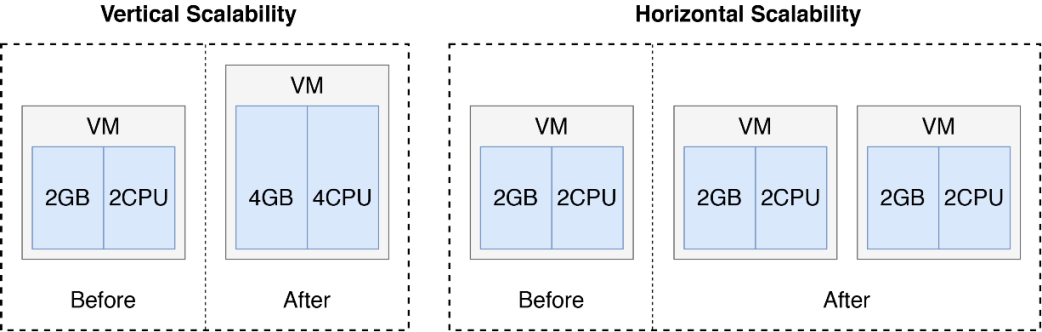
Figure 1.5. When you need to support increasing workloads, the vertical scalability model will add hardware resources to the computing node, while the horizontal scalability model will add more computing nodes.
portable across systems;

This is an excerpt from Manning's book Serverless Architectures on AWS, Second Edition.
If you ask software developers what software architecture is, you might get answers ranging from “it’s a blueprint or a plan” to “a conceptual model” to “the big picture.” This book is about an emerging architectural approach that has been adopted by developers and companies around the world to build their modern applications – serverless architectures. Serverless architectures have been described as somewhat of a “nirvana” for an application architectural approach, in that it promises developers the ability to iterate as fast as possible while maintaining business critical latency, availability, security, and performance guarantees – with minimal effort on the developers’ part. This book shows how to build these next generation of systems that can scale and handle demanding computational requirements without having to provision or manage a single server. Importantly, this book describes techniques that can help developers quickly deliver products to market while maintaining a high level of quality and performance by using services and architectures offered by today’s cloud platforms.
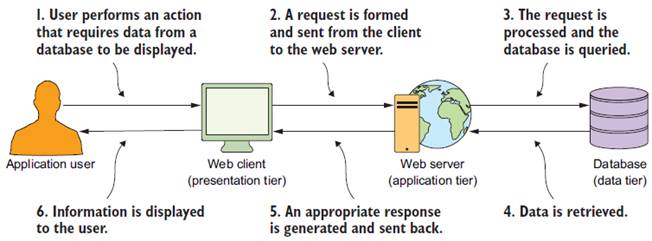
Let’s take the example of a typical data-driven web application, not unlike the systems powering most of today’s web-enabled software. These consist of a backend that accepts HTTP requests from the front end and then processes the requests. The backend servers perform various forms of computation and the client-side front ends provide an interface for users to operate via their browser, mobile, or desktop device. Data might travel through numerous application layers before being saved to a database. The backend, finally, generates a response—it could be in the form of JSON or fully rendered markup—which is sent back to the client (figure 1.1). These kinds of applications are conventionally architected as “tiers” – a presentation tier that controls how the information is captured and provided to the user, an application tier that controls the business logic of the application, and a data tier with the database and corresponding access controls.
Figure 1.1 This is a basic request-response (client-server) message exchange pattern that most developers are familiar with. There’s only one web server and one database in this figure. Most systems are much more complex.
Software architectures has evolved from the days of code running on a mainframe to multitier architecture where the presentation, data, and application/logic tiers are traditionally separated. Within each tier there may be multiple logical layers that deal with particular aspects of functionality or domain. There are also cross-cutting components, such as logging or exception-handling systems, that can span numerous layers. The preference for layering is understandable. Layering allows developers to decouple concerns and have more maintainable applications. Figure 1.2 shows an example of a tiered architecture with multiple layers including the API, the business logic, the user authentication component, and the database.
This is an excerpt from Manning's book Cloud Native Patterns: Designing change-tolerant software.
In the past, implementing these failover behaviors was generally a bespoke solution, bolted on to a deployment for a system that wasn’t initially designed to adapt to underlying system failures. The knowledge needed to achieve the required SLAs was often limited to a few “rock stars,” and extraordinary design, configuration, and testing mechanisms were put in place in an attempt to have systems that reacted appropriately to that failure.
Risky deployments— The landscape in which software is deployed today is highly complex, with many tightly coupled, interrelated components. As such, a great risk exists that a deployment bringing a change in one part of that complex network will cause rippling effects in any number of other parts of the system. And fear of the consequences of a deployment has the downstream effect of limiting the frequency with which you can deploy. Change is the exception— Over the last several decades, we generally wrote and operated software with the expectation that the system where it ran would be stable. This philosophy was probably always suspect. But now, with IT systems being complex and highly distributed, this expectation of infrastructure stability is a complete fallacy.[1] As a result, any instability in the infrastructure propagates up into the running application, making it hard to keep running. 1Wikipedia’s “Fallacies of Distributed Computing” entry (http://mng.bz/pgqw) provides more details.
For those of you who previously might not have done much with eventual consistency, this might feel a bit like rocket science. An expert colleague avoids using the term eventual consistency because he worries that it’ll invoke fear in our customers. But systems built on this model are increasingly common, and many tools and educational materials can assist in bringing such solutions to fruition.

This is an excerpt from Manning's book The Cloud at Your Service: The when, how, and why of enterprise cloud computing.
In the 1960s, we saw the development of the first commercial mainframes. In the beginning, these were single-user systems, but they evolved in the 1970s to systems that were time-shared. In this model, the large computing resource was virtualized, and a virtual machine was allocated to individual users who were sharing the system (but to each, it seemed that they had an entire dedicated machine).
Although technically correct, this definition has some drawbacks. In practice, it’s generally straightforward to measure the number of successes in using an application by looking, for example, at log files or other records of activity. The number of tries is less straightforward to measure. Whereas you can measure the number of errors that caused an availability issue when the application is more or less running properly, in the event that the system is down, you have no way of knowing how many users tried to use the application when it wasn’t available.

This is an excerpt from Manning's book Azure in Action.
Provide a mechanism that manages what’s running where and enforces permissions in the system
A common architectural goal during design is to produce a system that’s tightly integrated, but also loosely coupled. Any sizable system usually has several components, and whether these components are running in the same memory space, or on different boxes, they need to work closely together. This is what is meant by “tightly integrated.” These different components should work as a team to provide the value of the system in an easy and cohesive manner.
If your only goal is tight integration, you’ll often end up with a system where the components are tightly coupled as well. Tight coupling leads to a system that’s brittle and that responds poorly to changes. This makes it difficult to manage the system and to extend it to meet future needs. In a brittle system, a change in one component can ripple through the whole system, requiring changes in many other components. Such a system is difficult to understand, maintain, and troubleshoot.