concept authenticity in category cryptography

This is an excerpt from Manning's book Real-World Cryptography.
Note that this long digest is controlled by the owner(s) of the webpage, and it could easily be replaced by anyone who can modify the webpage. (If you are not convinced about this take a moment to think about it.) This means that we need to trust the page that gave us the digest, its owners and the mechanism used to retrieve the page (while we don’t need to trust the page that gave us the file we downloaded). In this sense, the hash function alone does not provide integrity. The integrity and authenticity of the downloaded file comes from the digest combined with the trusted mechanism which gave us the digest (HTTPS in this case, we will talk about HTTPS in chapter 9 but for now imagine that it magically allows you to communicate securely with a website).
In the previous chapter 2, you’ve learned about an interesting construction (a hash function) that on its own does not provide much, but if used in combination with a secure channel allows us to verify the authenticity and integrity of messages. In this chapter, we will see how one can provide integrity and authenticity over messages without the use of a secure channel.
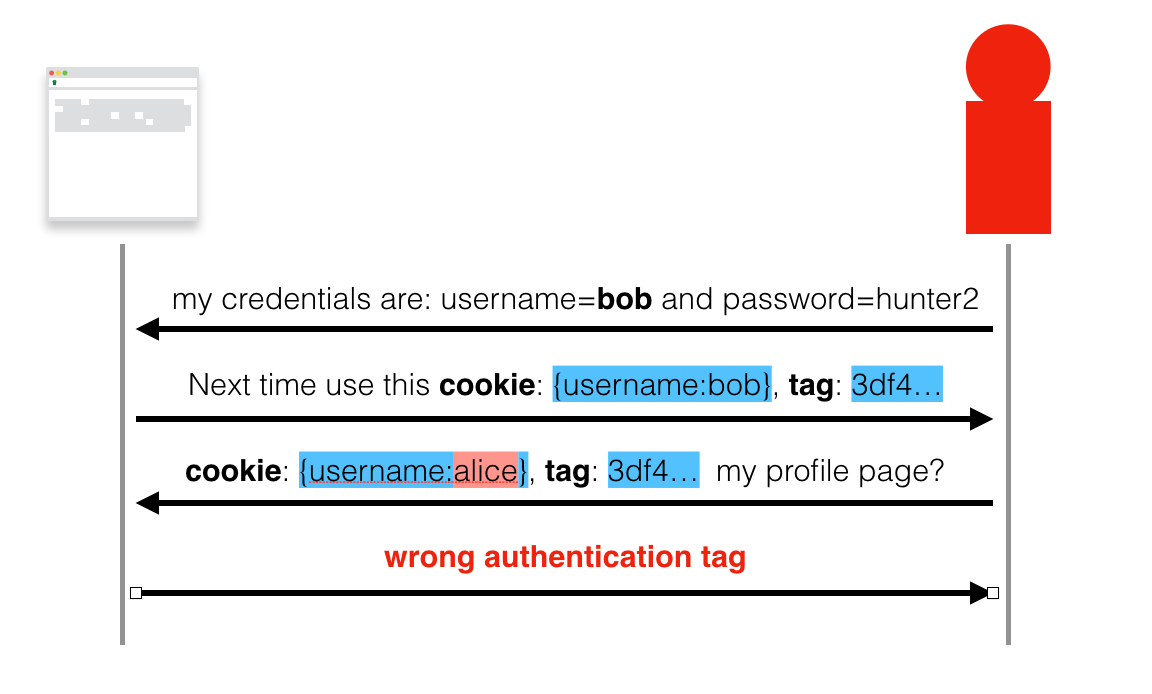
To secure our cookie’s integrity and authenticity with a MAC, we can simply remember one secret key and use it to generate an authentication tag on the cookie as seen in figure 3.5.
Figure 3.5. A malicious user tampers with his cookie, but cannot forge a valid authentication tag for the new cookie. Subsequently, the webpage cannot verify the authenticity and integrity of the cookie, and thus discard the request.