concept connection in category cryptography

This is an excerpt from Manning's book Real-World Cryptography.
AES-GCM is included in NIST’s Special Publication 800-38D since 2007,[14] is FIPS approved,[15] and was also part of NSA’s suite B (a suite of algorithms that can be used by the US government to protect unclassified and classified information). It is the main cipher used in many protocols, including several versions of the TLS protocol which is used to secure connections to websites on the Internet. Effectively, we can say that AES-GCM encrypts the web.
In TLS terms, the two participants that want to secure their communications are called a client and a server. The client always being the one that initiates the connection.
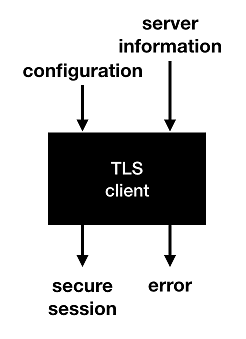
Once given these two arguments, a client interface produces a secure session (a stateful connection that expires, unless kept alive) that the application can use to securely communicate with the server. In some cases a secure session cannot successfully be created and fails midway. For example, if an attacker attempts to tamper with the connection, or if the server configuration is not compatible with the client’s (more on that later).
Figure 9.4. A client in TLS is the one who initiates the connection. For example in HTTPS, the web browser is the client. A client must be configured, and must be provided with enough information about the server it wants to connect to (typically an ip address and port) to create a secure connection with it.