concept key in category cryptography

This is an excerpt from Manning's book Real-World Cryptography.
A cryptographic algorithm can be considered broken in many ways. For an encryption algorithm, you can imagine several ways to attack the algorithm: the secret key can be obtained somehow, messages can be decrypted without the help of the key, some information about the message can be revealed just by looking at the encrypted message, and so on. Anything that would somehow weaken the assumptions we made about the algorithm could be considered a break.
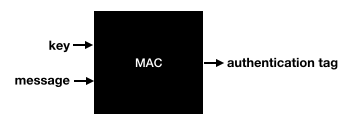
Figure 3.4. The interface of a Message Authentication Code. The algorithm takes a secret key and a message, and deterministically produces an unique authentication tag. Without the key, it should be impossible to reproduce that authentication tag.
Whitebox cryptography is exactly this: a field of cryptography that attempts to scramble a cryptographical implementation with the key it uses, in order to prevent extraction of that key. That’s right, the attacker can be given the source code of some whitebox AES-based encryption algorithm with a fixed key, and it will encrypt and decrypt fine, but the key is mixed so well with the implementation that it will be too hard for anyone to extract it from the algorithm. That’s the theory at least. In practice, no published whitebox crypto algorithm has been found to be secure, and most commercial solutions are closed-source due to this fact (security through obscurity kinda works in the real-world, but should generally not be relied upon).[2] Again, it’s all about raising the cost and making it harder for attackers.