concept knowledge in category cryptography
appears as: knowledge, knowledge

This is an excerpt from Manning's book Real-World Cryptography.
Asymmetric cryptography (or public-key cryptography). Participants have an asymmetrical view of the secrets. For example, some will have knowledge of a public key, while some will have knowledge of both a public and private key.
In this sense, signatures are somewhat similar to the message authentication codes (MACs) you’ve learned about in chapter 3. But unlike MACs, they allow one to authenticate messages asymmetrically: a participant can verify that a message hasn’t been tampered, without knowledge of the private or signing key.
Figure 7.5. A proof of knowledge has two participants. Alice (the prover) wants to prove that she knows the discrete logarithm of a group element to Bob (the verifier).
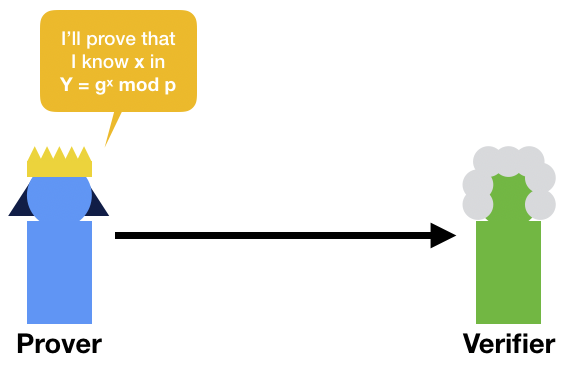
Of course, the simplest approach to this problem is for Alice to simply send the value x (called the witness) as in figure 7.6. This would be a simple proof of knowledge, and this would be OK unless Alice does not want Bob to learn it.