concept PGP in category cryptography

This is an excerpt from Manning's book Real-World Cryptography.
Yet, in the details PGP is actually quite bad.
The OpenPGP standard and its main implementation GPG make use of old algorithms and ways. The most critical issue is that encryption is not authenticated, which means that anyone intercepting an email that hasn’t been signed might be able to tamper with the encrypted content to some degree depending on the exact encryption algorithm used. For this reason alone I would not recommend anyone to use PGP today.
A surprising flaw of PGP comes from the fact that the signing and encryption operations are composed without care. In 2001 Don Davis pointed out that because of this naive composition of cryptographic algorithms, one can re-encrypt a signed email they received to another recipient. Effectively allowing Bob to send you the email Alice sent him, like you were the intended recipient.
I spent some pages to talk about how a simple design like PGP can fail in a lot of different and surprising ways in practice.
I would recommend against using PGP.
While email encryption is still an unsolved problem, alternatives are being developed to replace different usecases of PGP.
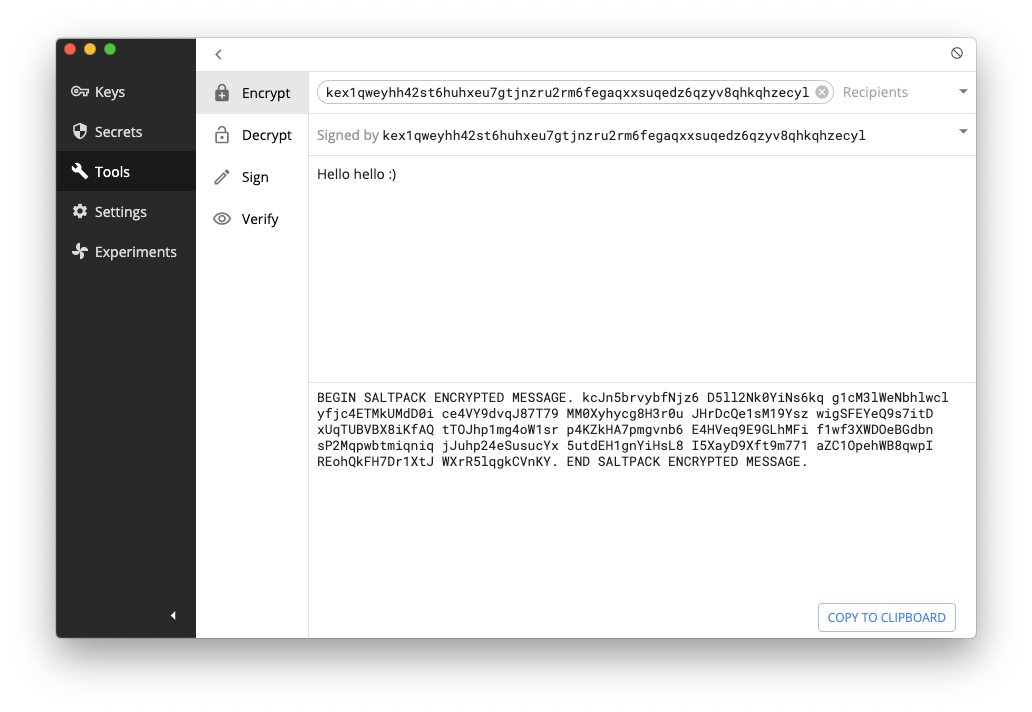
Saltpack is a similar protocol and message format to PGP. It attempts to fix some of the PGP flaws I’ve talked about.[69] Its main implementations, at the moment of this writing, are keybase (keybase.io/) and keys.pub (keys.pub/). (See figure 10.6 for an illustration of the keys.pub tool.)
Figure 10.6. keys.pub is a native desktop application implementing the saltpack protocol. You can use it to import other people’s public keys, and encrypt and sign messages to them.
These implementations have all moved away from the web of trust, and allow users to broadcast their public keys on different social networks in order to instill their identity into their public keys (as illustrated in figure 10.7). PGP could obviously not have thought about this key discovery mechanism, as it predates the boom of social networks.
Figure 10.7. A keybase user broadcasting their public key on the Twitter social network. Allowing other users to obtain additional proof that his identity is linked to a specific public key.

On the other hand, most secure communication nowadays is far from a one-time message, and the use of these tools is less and less relevant. In the next section I talk about secure messaging, one of the field that aims at replacing the communication aspect of PGP.
[67] in his 1991 essay "Why Do You Need PGP?", Philip Zimmermann ends with "PGP empowers people to take their privacy into their own hands. There’s a growing social need for it. That’s why I wrote it."