concept symmetric key in category cryptography

This is an excerpt from Manning's book Real-World Cryptography.
In our discussion about symmetric encryption, we said that Alice and Bob first met to decide on a symmetric key. This is a plausible scenario, and a lot of protocols actually do work like this. Nonetheless, this quickly becomes less practical as our scenario scales: do we need our web browser to meet with Google, Facebook, Amazon, and the other billions of websites before being able to securely connect to them? This problem, often referred to as key distribution has been a hard one to solve for quite a long time, at least until the discovery in the late 70’s of another large and useful category of cryptographic algorithms called asymmetric cryptography or public-key cryptography. Asymmetric cryptography generally makes use of different keys for different functions (as opposed to a single key being used in symmetric cryptography), or provides different point of views to different participants. To illustrate what this mean, and how public-key cryptography helps to set up trust between people, we will now uncover a number of asymmetric primitives.
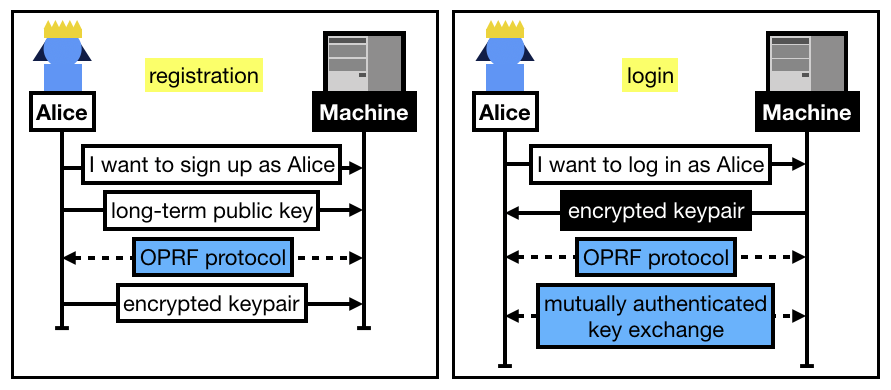
Figure 11.8. To register to a server using OPAQUE, Alice generates a long-term keypair and send her public key to the server who stores it and associates it with Alice’s identity. She then uses the OPRF protocol to obtain a strong symmetric key from her password, and send an encrypted backup of her keypair to the server. To log in, she obtains her encrypted keypair from the server, then performs the OPRF protocol with her password to obtain a symmetric key capable of decrypting her keypair. All that’s left is to perform a mutually-authenticated key exchange (or possibly sign a challenge) with this key.
For this reason, symmetric keys are yet another not-perfect replacement for passwords.