concept " be - an " relationship in category dart
This is an excerpt from Manning's book Dart in Action.
When classes inherit each other, the subclass gains the functionality of the methods and properties of the parent class, known as the superclass. The subclass also shares an “is-an” relationship with all the parent classes going up the hierarchy.
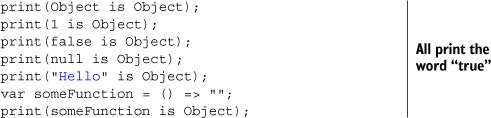
Object inheritance creates an “is-an” relationship going up the hierarchy, and this “is-an” relationship can be tested in code, using the is keyword, which returns a Boolean true or false value. The following statements all return true:
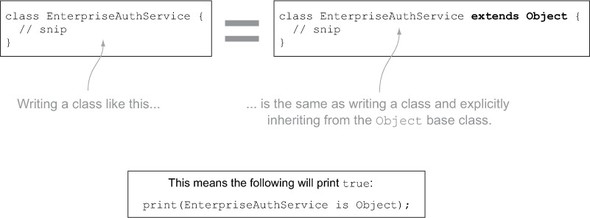
You can use the “is-an” relationship with your own classes. When you create a new class, such as EnterpriseAuthService, you’re automatically inheriting from the base Object class. To create an “is-an” relationship with inheritance, use the extends keyword to define the parent of the class you’re inheriting. But this isn’t required with Object; you get the inheritance automatically without needing to use the extends keyword, as shown in figure 7.6.
This inheritance works all the way down the inheritance hierarchy. When your EnterpriseUser inherits from User, it too inherits from the base Object class but via the User class. This inheritance happens because inheritance provides an “is-an” relationship up the class hierarchy, meaning that each child has an “is-an” relationship with every parent going up the hierarchy, as shown in figure 7.7.