concept BBC in category data

This is an excerpt from Manning's book Linked Data: Structured data on the Web.
Where is your data in the age of the Web? Your data, like the books and music of a few years ago, is mostly stuck in proprietary containers, such as relational databases and spreadsheets. Your data is generally read via the containers in which it was created, whether relational databases or spreadsheet programs. Your data is hierarchical, and so are the systems that support it. The BBC worked around this problem in a novel way by both pulling information from the Web and curating it to ensure its accuracy.
Now let’s turn our attention to the BBC and how its development team used Linked Data to gather information from the Web, ensure its accuracy, and reuse it to automatically create deep and complex websites.
The data needed by the BBC already existed on public services scattered around the Web. The BBC realized that it could collect and repurpose some of this data to more rapidly build its new sites.
The BBC uses Linked Data to generate web presences for three of its web properties: BBC Programmes (http://www.bbc.co.uk/programmes), BBC Music (http://www.bbc.co.uk/music), and Wildlife Finder (http://www.bbc.co.uk/nature/wildlife). Web presences for more than 1,500 daily television and radio broadcasts are created in BBC Programmes alone. To make such a tall order practical, the development team uses public data that already exists on the Web.
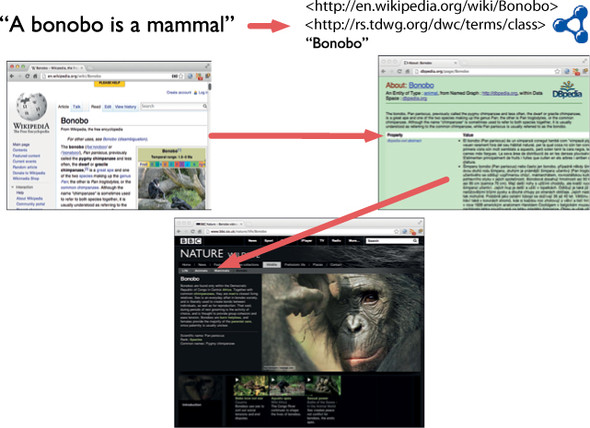
The BBC collects, filters, and reuses Linked Data from various sources, including the World Wildlife Fund, MusicBrainz (http://musicbrainz.org/), and the DBpedia project. For example, DBpedia extracts structured data from Wikipedia (the parts of a Wikipedia page you see in the upper-right corner of their pages) and converts it into Linked Data, as shown in figure 1.4. The BBC then uses DBpedia’s Linked Data to enhance information presented about musical artists and wildlife species discussed in its broadcasts. Linked Data gathered from other sites is managed in a similar way. Because Linked Data shares a common data model (discussed in chapter 2), the data from those sites may be immediately combined.
Figure 1.4. DBpedia converts structured information from Wikipedia’s info boxes into Linked Data. The BBC uses content from DBpedia and other Linked Data sources to create three of its web properties (BBC Wildlife Finder is shown).
In using Linked Data, the BBC has turned traditional content-management concepts on their heads. If BBC editors find an error or need to make a change, instead of making the change on their own site, they often make the change on someone else’s website. BBC editors curate third-party Web content to make their own site more factually correct, while improving our common knowledge resources. Of course, the BBC editors can do this only because they are allowed to write into sites like Wikipedia.