concept context in category data

This is an excerpt from Manning's book Algorithms and Data Structures for Massive Datasets.
The first time the consistent hashing came to a spotlight was in the context of web caching.[24],[25] Caches are one of those good things in life, and one of the fundamental ideas that improve systems across the domains in computer science. In the context of web, for example, caches carry a great significance by relieving the hot spots when many clients request the same web page from a server. The general setup is that servers host web pages, clients request them via browsers, and caches sit in between to host copies of frequently accessed web pages. Once a cache miss occurs, a cache fetches a website from the originating server; in most situations, caches are able to satisfy the request faster than the home servers, and distribute the load so that the hot spots do not occur.
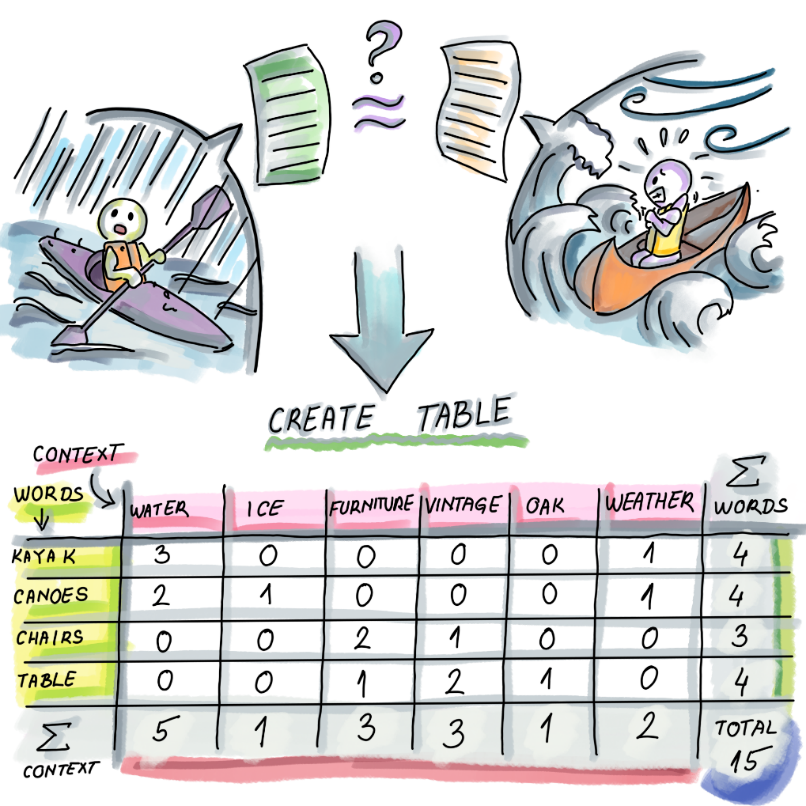
The distributional similarity problem asks that, given a large text corpus, we find pairs of words that might be similar in meaning based on the contexts in which they appear, or as a well-known linguist John R. Firth put it: “You will know a word by a company it keeps”. So for example, the words ‘kayak’ and ‘canoe’ will appear surrounded by similar words like ‘water’, ‘sport’, ‘weather’, ‘equipment’, etc. As a context for a given word, usually the window of size k (e.g., k = 3) is chosen, including k words before and k words after the given word, or less if we are on the boundary of a sentence.
Figure 4.6: To preprocess the text corpus for computing PMI, one way is to create a matrix M where the entry M[A][B] contains the number of times the word A appears in the context B. So for example, ‘kayak’ appears 3 times in the context of ‘water’ and 0 times in the context of ‘furniture’. We also produce the additional count for each word (the last column of the matrix), and count for each context (the last row in the matrix), as well as the total number of words (lower right corner).

This is an excerpt from Manning's book The Art of Data Usability.
Thinking of the model as a pyramid or a flow helps visualize the relationship between these four models. Data comprises records of facts or observations. Processing the data changes it into information. Analyzing the information and putting it into context generates knowledge. By attaining and really understanding the knowledge, it can then be applied to situations in which it becomes wisdom.