concept data project in category data

This is an excerpt from Manning's book The Art of Data Usability.
It’s difficult to teach data usability in a book because data projects vary in tools and techniques, the subject of the data, the size of the project or the team, geographical distribution, and legal environment. The fact is, data is everywhere; it’s all around us, and we take different approaches to try to understand and use it.
If you only think about accuracy (and timeliness) you’re only thinking about the quality of the data points. In my opinion we need to think about quality for the users of the data, the information, and the knowledge. To do that we must think about what quality attributes are applicable in each stage of our data project’s life-cycle. That’s the reason I need to discuss structure of a data project before we can continue our journey into data quality.
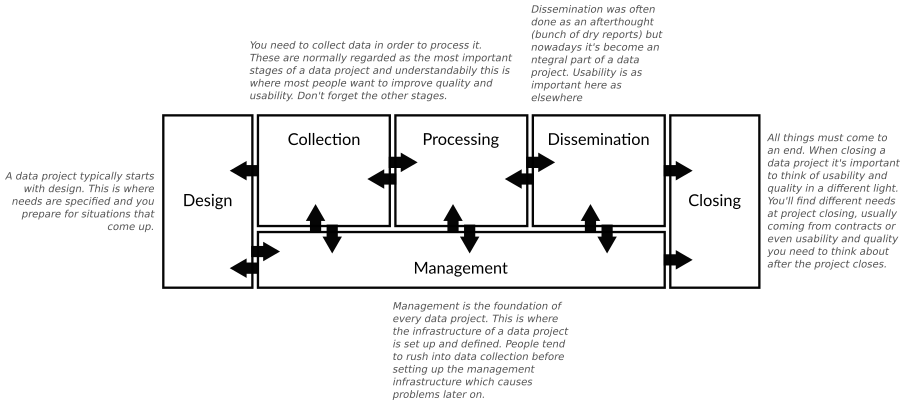
This chapter introduces a generic structure for data projects. It is important to be aware of the different stages of a data project when identifying needs (discussed in the next chapter), as shown in figure 3.1.
Figure 3.2. Structure of a data project
Listing 9.2. blogpost.markdown
--- Title: A word about machine readability Author: Book Readerperson --- Many people think a machine-readable file is the same as being digital file. That's **not** correct. Machine readability is about having data files that can be parsed by computers automatically (using predefined rules). Many data publishers provide data in *PDF* files. PDF can't be easily parsed because the format allows for all kinds of documents and it's not easy to extract the data without a human telling the computer where it can find the data. *CSV* files, on the other hand, are pure data formats. You only have to point a computer program at the CSV file and it'll know how to read the data from the file (it does however not know how to process it). Now. The question is: Do advances in AI and machine learning make machine readability less important for data projects?