concept dataset in category data

This is an excerpt from Manning's book Data Science Bookcamp: Five Python Projects.
The least-penalized center is a good measure of centrality. It minimizes all the penalties incurred for being too far from any given point. This leads to balanced distances between the center and every data-point. Unfortunately, our computation of that center was very inefficient. Scanning all possible penalties is not a scalable solution. Is there a more efficient way to compute the center? Yes! Mathematicians have shown that sum of squared distances error is always minimized by the average value of a dataset. Thus, we can compute the least-penalized center directly. We simply need to sum all the elements in
measurementsand then divide that sum by the array size.
Centering our data at the origin is trivial. The central point of every dataset is equal to its mean. Thus, we need to adjust our coordinates so that their x-value mean and y-value mean both equal zero. This can be done by subtracting the current mean from every single coordinate. In other words, subtracting the mean height for
heightsand the mean weight fromweightswill produce dataset that’s centered at (0, 0).

This is an excerpt from Manning's book The Art of Data Usability.
Data should actually be a plural word because data is a collection, but it is also correct to use data as a singular word because it can be treated as a mass noun, just like information. The plural data is mostly tied to scientific community, whereas singular data is used more in everyday conversations. When I think of data, I always think of it as a dataset, not data in the theoretical sense, so I’ll be using it as a mass noun, in the singular form.
Listing 2.2. gzip_dataset.py
import gzip import click import shutil @click.command() @click.argument('filename', type=click.Path(exists=True)) def gzip_dataset(filename): gzip_filename = '{name}.gz'.format(name=filename) #1 with open(filename, 'rb') as dataset: #2 with gzip.open(gzip_filename, 'wb') as dataset_gzipped: #3 shutil.copyfileobj(dataset, dataset_gzipped) #4 if __name__ == '__main__': gzip_dataset() #1 Create the gzip filename #2 Open the original csv file. #3 Use gzip to open output file #4 Copy contents of source into output file
Completeness is the measure of how well you have covered a specific area. The area where I usually think about completeness (where I can measure it best) is metadata. Other important areas are for example statistical populations or datasets that represent finite lists, specific (optional) values in the dataset. Let’s focus on metadata to begin with.
This is an excerpt from Manning's book Think Like a Data Scientist: Tackle the data science process step-by-step.
Whereas in chapters 12 and 13 the vocabulary was made up of the words from the dataset, now the vocabulary is made up the characters in the dataset. As such, the dataset is also transformed into a list of indices corresponding to characters instead of words. Above this is the indices NumPy array:
But in 2017, Google published a very exciting paper and blog post that made a significant dent in this conversation. Google proposed that we don’t need to centralize a dataset in order to train a model over it. The company proposed this question: what if instead of bringing all the data to one place, we could bring the model to the data? This is a new, exciting subfield of machine learning called federated learning, and it’s what this chapter is about.

This is an excerpt from Manning's book Linked Data: Structured data on the Web.
Life sciences (including some large pharmaceutical companies) contribute over 50% of the links between datasets. Publication data (from books, journals, and the like) comes in second with 19%, and the media domain (the BBC, the New York Times, and others) provides another 12%.
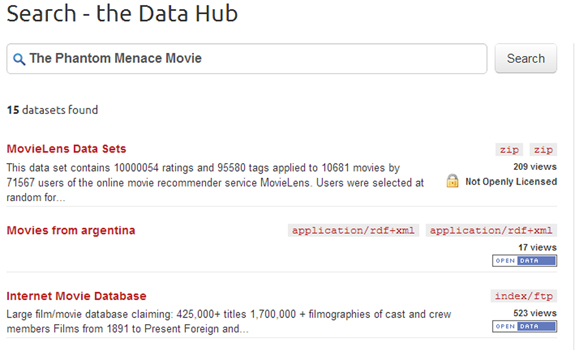
A dataset is a collection of related data that’s published, maintained, or aggregated by a single provider. It’s often available as RDF and accessible, for example, through dereferenceable HTTP URIs or a SPARQL endpoint.
VoID was introduced in 2009. It’s an RDF schema vocabulary for expressing metadata about RDF datasets. It’s intended as a bridge between the publishers and users of RDF data, with applications ranging from data discovery to cataloging and archiving of datasets. This section presents an overview of the VoID vocabulary. It contains terms that enable you to express general metadata, access metadata, structural metadata, and links between datasets. It also provides deployment advice and discusses the discovery of VoID descriptions. Table 8.2 shows an overview of this vocabulary.