concept goal in category data

This is an excerpt from Manning's book Build a Career in Data Science.
If not, I’d start by trying to understand the motivations and goals of the other person. Suppose that this person was the vice president of sales and they had done an analysis showing that each salesperson they hired brought in more than twice their salary in sales. Then they used this analysis to justify hiring five more people for the team. If I show that each salesperson actually brings in less than their salary, that could jeopardize the whole sales department. People would have a lot riding on the outcome so it would be important to be careful.
Everyone has goals when working a job—objectives they want to achieve when they go to work every day. Those goals are determined both by the job a person has and their personal traits such as ambition and a desire for career-life balance. A lead engineer, for example, may focus on getting their current project complete so that they can get a promotion. Or a senior executive may know that they are going to leave the company soon and want to avoid rocking the boat before then. These goals shape what people do at work and how they respond to other people’s actions. A project that takes longer than expected could be terrible for the promotion-oriented engineer but great for the executive who doesn’t want to do anything.
When you’re working with stakeholders as a data scientist, it’s critical that you understand their goals. Exactly the same analysis could be received well or poorly, depending on the stakeholder’s perspective. Consider an analysis of the performance of a certain product being sold on the company website. Suppose that the stakeholder is the person who manages that product, and your analysis found that the product was not selling well in South America. If the stakeholder had the goal of making the product seem to be amazing to the company because it was their idea, the analysis could be received very poorly because it shines a light on the problem. On the other hand, if the stakeholder had the goal of keeping an entire portfolio of products performing well, knowing which one may need to be cut is very helpful.
This is an excerpt from Manning's book Think Like a Data Scientist: Tackle the data science process step-by-step.
The goals would require, respectively:
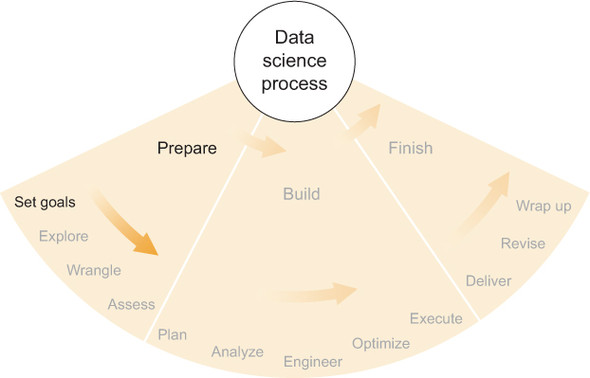
Figure 2.1 shows where we are in the data science process: setting goals, which is the first step of the preparation phase. In a data science project, as in many other fields, the main goals should be set at the beginning of the project. All the work you do after setting goals is making use of data, statistics, and programming to move toward and achieve those goals. This chapter emphasizes how important this initial phase is and gives some guidance on how to develop and state goals in a useful way.
If the goal is to build a product that makes reading news more efficient, maybe there’s another way to address the problem of inefficient news readers. Perhaps it’s easier to aggregate similar articles and present them together to the reader. Maybe it’s possible to design a better news reader through friendlier design or by incorporating social media.