concept Linked Data in category data

This is an excerpt from Manning's book Linked Data: Structured data on the Web.
You already know some of the techniques we use for Linked Data because you understand HTTP, URIs, and hyperlinks. You want to publish data on the Web, and you use URIs to identify data elements and the relationships between them. You can use those URIs to hyperlink between data elements the way web pages are hyperlinked. Linked Data is just data but it’s on the Web and structured the way the Web is structured. These ideas are collected into the Linked Data principles, described in more detail in section 1.4.
Figure 1.1. The 5-Star Linked Data mug, available from cafepress.com. The mug may be ordered either with the “Open” and “Open license” labels or without them; Linked Open Data uses both, Linked Data uses neither. Sales of the mugs benefit the W3C.
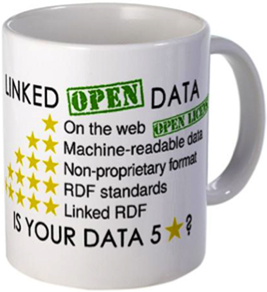
Linked Data (pardon the repeated definition) is a set of techniques for the publication of data on the Web using standard formats and interfaces. We also call data that conforms to those techniques Linked Data.
You might be wondering whether Linked Data is too good to be true. It’s not. Linked Data is built on the Web and has the same benefits and problems that the Web does.
Linked Data is no silver bullet. It won’t protect you from issues of data quality or from service failures. Nothing inherent to Linked Data improves the efficiency of distributed queries. The same goes for changing definitions of schema terms. If the meaning of your terms changes in time, your data might be more difficult to understand in the context in which it was developed.
But Linked Data does provide you with new ways to manage these existing data-management challenges.
Data quality is a problem in every data-management system. Dirty data in a relational database or on a website can very rapidly be turned into dirty Linked Data. You’ll find that Linked Data is most often published in ways that aren’t specific to a particular application. That can expose data cleanliness issues that weren’t previously transparent and at the same time make them easier to spot. Many sites structure their reuse of Linked Data so that it may be reviewed and even curated before it’s used, as you’ll see with the BBC example later in this chapter. Others don’t and put up with dirty data as a consequence. As always, the choice is yours.
What will you do if you’re using Linked Data from a service on the Web and that service shuts down or becomes temporarily unavailable? Most people won’t build production services that query distributed data in real time, for issues of both reliability and efficiency. You can treat your local copy of some remote data as a sort of cache. The failure of a remote service just means that your data may not be up to date until the service returns to operation or a replacement is found.
What about changing schema terms? Linked Data schema terms are identified using HTTP URIs, so it’s relatively easy to migrate to another URI if the meaning of a term changes. Even if you don’t change a URI for a term, you can (and should) generally record some information about where and when the definition of terms was valid. There are even ways to check for equivalent terms. Linked Data offers several layers of flexibility to help you with changing schemas.