concept numpy in category data

This is an excerpt from Manning's book Data Science Bookcamp: Five Python Projects.
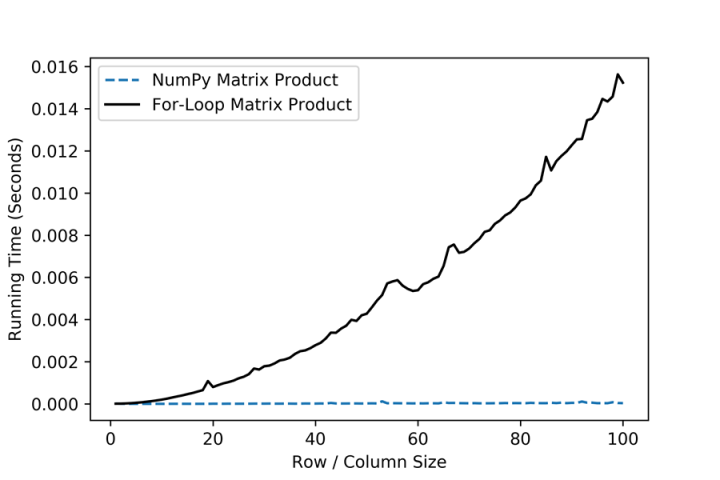
NumPy, which stands for Numerical Python, is the engine that powers Pythonic data science. Python, despite its many virtues, is simply not suited for large-scale numeric analysis. Hence, data scientists must rely on the external NumPy library to efficiently manipulate and store numeric data. NumPy is an incredibly powerful tool for processing large collections of raw numbers. Thus, many of Python’s external data-processing libraries are NumPy-compatible. One such library is Matplotlib, which we introduced in the previous section. Other NumPy-driven libraries will be discussed in later portions of the book. This section focuses on randomized numerical simulations. We will leverage NumPy to analyze billions of random data-points. These random observations will allow us to learn hidden probabilities.
Figure 13.16. Matrix-size plotted against product running-times for NumPy and regular Python. NumPy is vastly faster than regular Python.