concept step in category data
This is an excerpt from Manning's book Mastering Large Datasets with Python: Parallelize and Distribute Your Python Code.
This is a straightforward way of programming; however, it limits us to executing one instruction at a time (figure 1.1). Steps 2 and 3 need to resolve before we can move on to Step 4. And Step 4 routes us back to Steps 2 and 3, leaving us in the same pickle.
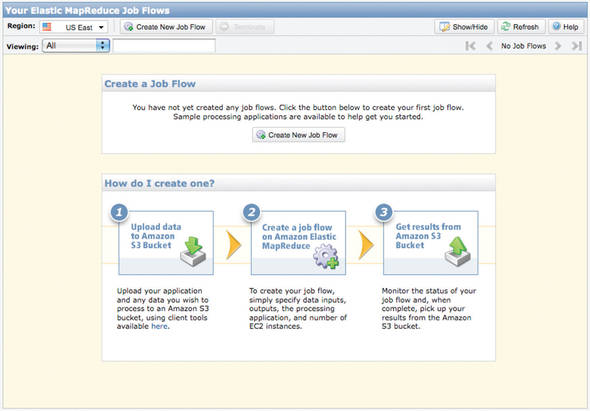
MapReduce is an implementation of the map and reduce steps you’ve already seen in this book that is designed to work in parallel on distributed clusters. YARN is a job scheduling service with cluster management features. HDFS—or Hadoop Distributed File System—is the data storage system of Hadoop. Ozone is a new (version 0.3.0 as I’m writing this) Hadoop project that provides for semantic object store capabilities. Common is a set of utilities common to all the Hadoop libraries.
With Hadoop Streaming, we need to manually ensure that the data can pass between the map and reduce steps. What do we need to call at the end of each step? (Choose one.)
Using configs in /etc/mrjob.conf
No configs specified for inline runner
Creating temp directory /tmp/common-errors.jt-w.20191108.012559.032175
Running step 1 of 1...
job output is in /tmp/common-errors.jt-w.20191108.012559.032175/output
Streaming final output from /tmp/common-errors.jt-
     w.20191108.012559.032175/output...
".hdr.sgml"    2
".txt"    191
"form448073_20120210093319-.xml"    1
Removing temp directory /tmp/common-errors.jt-w.20191108.012559.032175...

This is an excerpt from Manning's book Think Like a Data Scientist: Tackle the data science process step-by-step.
To compare with carpentry, knowing how to use hammers, drills, and saws isn’t the same as knowing how to build a chair. Likewise, if you know the process of building a chair, that doesn’t mean you’re any good with the hammers, drills, and saws that might be used in the process. To build a good chair, you have to know how to use the tools as well as what, specifically, to do with them, step by step. Throughout this book, I try to discuss tools enough to establish an understanding of how they work, but I focus far more on when they should be used and how and why. I perpetually ask and answer the question: what should be done next?
Starting Training Round...
  Step 1: send the model to Bob
  Loss:0.21908166249699718

           ......

   Step 3: Send the model to Sue
 Loss:0.015368461608470256

 Average Everyone's New Models
 % Correct on Test Set: 98.8
I probably should have put this as step 1, but here goes. Nothing has boosted my knowledge of deep learning (and my career in deep learning) more than teaching deep learning on my blog. Teaching forces you to explain everything as simply as possible, and the fear of public shaming will ensure that you do a good job.
This is an excerpt from Manning's book Hadoop in Action.
A lot of data processing tasks involve record-oriented preprocessing and postprocessing. For example, in processing documents for information retrieval, you may have one step to remove stop words (words like a, the, and is that occur frequently but aren’t too meaningful), and another step for stemming (converting different forms of a word into the same form, such as finishing and finished into finish.) You can write a separate MapReduce job for each of these pre- and postprocessing steps and chain them together, using IdentityReducer (or no reducer at all) for these steps. This approach is inefficient as each step in the chain takes up I/O and storage to process the intermediate results. Another approach is for you to write your mapper such that it calls all the preprocessing steps beforehand and the reducer to call all the postprocessing steps afterward. This forces you to architect the pre- and postprocessing steps in a modular and composable manner. Hadoop introduced the ChainMapper and the ChainReducer classes in version 0.19.0 to simplify the composition of pre- and postprocessing.