concept direction in category deep learning

This is an excerpt from Manning's book Math and Architectures of Deep Learning.
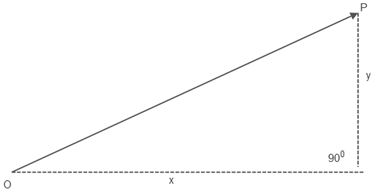
Figure 2.1: A vector describing the position of point P with respect to point O. The basic mental picture to have is an arrowed line. This agrees with the definition of vector we learnt in high school: vector has a magnitude (length of the arrowed line) and direction (indicated by the arrow). On a plane, this is equivalent to the ordered pair of numbers x, y, where the geometric interpretations of x and y are as shown in Figure. In this context, it is worthwhile to note that only the relative positions of the points O and P matter. If both the points are moved, keeping their relationship intact, the vector does not change.
Geometry of sampled point clouds - covariance and direction of maximum or minimum spread
We saw above that if a multivariate distribution has a covariance matrix ℂ, its variance (spread) along any specific direction Î is ÎT ℂÎ. What is the direction along which this spread is maximum?

This is an excerpt from Manning's book Grokking Deep Learning.
The real problem is that even though you know the correct direction to move weight, you don’t know the correct amount. Instead, you pick a fixed one at random (step_amount). Furthermore, this amount has nothing to do with error. Whether error is big or tiny, step_amount is the same. So, hot and cold learning is kind of a bummer. It’s inefficient because you predict three times for each weight update, and step_amount is arbitrary, which can prevent you from learning the correct weight value.