concept evolutionary algorithm in category deep learning
appears as: Evolutionary algorithms, n evolutionary algorithm, Evolutionary algorithm
This is an excerpt from Manning's book Deep Reinforcement Learning in Action.
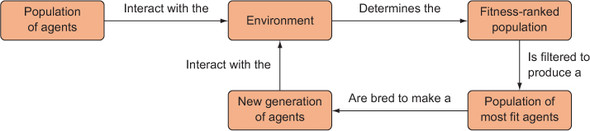
Evolutionary algorithms provide us with more powerful tools for our toolkit. Based on biological evolution, we Evolutionary algorithms tend to be more data hungry and less data-efficient than gradient-based approaches; in some circumstances this may be fine, notably if you have a simulator. Evolutionary algorithms can optimize over nondifferentiable or even discrete functions, which gradient-based methods cannot do. Evolutionary strategies (ES) are a subclass of evolutionary algorithms that do not involve biological-like mating and recombination, but instead use copying with noise and weighted sums to create new individuals from a population.