concept exercise in category deep learning

This is an excerpt from Manning's book Deep Learning with PyTorch.
If the first epoch seems to be taking a very long time (more than 10 or 20 minutes), it might be related to needing to prepare the cached data required by
LunaDataset. See section 10.5.1 for details about the caching. The exercises for chapter 10 included writing a script to pre-stuff the cache in an efficient manner. We also provide the prepcache.py file to do the same thing; it can be invoked withpython -m p2ch11 .prepcache. Since we repeat our dsets.py files per chapter, the caching will need to be repeated for every chapter. This is somewhat space and time inefficient, but it means we can keep the code for each chapter much more well contained. For your future projects, we recommend reusing your cache more heavily.
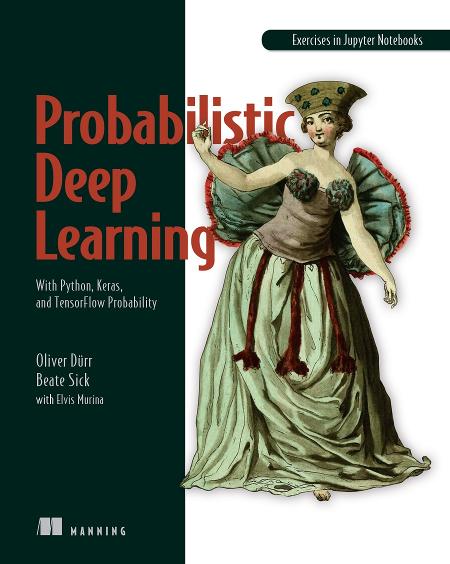
This is an excerpt from Manning's book Probabilistic Deep Learning: With Python, Keras and TensorFlow Probability.
This book gives you a hands-on introduction to probabilistic deep learning. We’ll provide exercises and code demos as Jupyter-notebooks that allow you to get experiences and so gain a deeper understanding of the concepts. To benefit from the book, you should already know how to run simple Python programs and how to fit a model to data (a simple model such as a linear regression is fine). For a deep understanding of the more advanced sections (indicated by an asterix) you should be fluent with intermediate math such as matrix algebra and differential calculus, as well as with intermediate statistics such as interpreting probability distributions.
But before dealing with continuous distributions and integrals to derive the analytical solution, let’s again use the brute force approach. We recommend that you follow the code in the notebook and do the exercises.