concept NLP in category deep learning

This is an excerpt from Manning's book Deep Learning for Natural Language Processing.
But from the perspective of automated analysis of language, with less high-ranking ambitions like sentiment analysis, topic classification, or question answering, the role and benefits of such linguistic structure are much less clearcut. In this engineering-oriented field, we have a different research question: how much structure do we actually need at a bare minimum to create practical NLP solutions? In this book, we will go through several NLP topics that shed a light on this issue. But first, let’s quickly pace through some of the major approaches to applied linguistics and NLP.
Originating from the field of formal linguistics in the 1950s and 1960s, and heavily borrowing from neighboring fields like computer science, logic, statistics, neuroscience and even psychology, NLP has gone through several creative cycles, with different orientations and success rates.
1 Deep learning for NLP
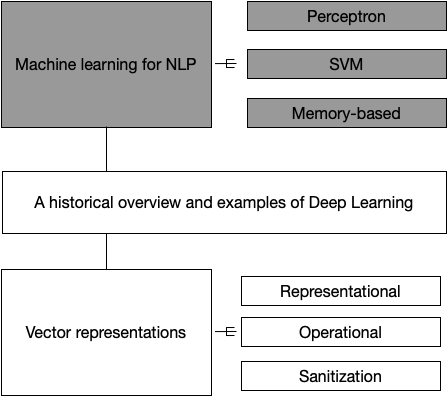
Language comes naturally to humans, but is traditionally hard to grasp for computers. This book addresses the application of recent and cutting-edge deep learning techniques to automated language analysis. Deep learning has emerged in the last decade as the vehicle of the latest wave in AI. Results have consistently redefined the state-of-the-art for a plethora of data analysis tasks in a variety of domains. For an increasing amount of deep learning algorithms, better-than-human (human-parity or superhuman) performance has been reported: for instance, speech recognition in noisy conditions, and medical diagnosis based on images. Current deep learning-based natural language processing (NLP) outperforms all pre-existing approaches with a large margin. What exactly makes deep learning so adequate for these intricate analysis tasks, in particular language processing? This chapter presents some of the background necessary for answering this question. We will guide you through a selection of important topics in machine learning for NLP.
Figure 1.2. Machine learning for NLP.