concept nodule candidate in category deep learning

This is an excerpt from Manning's book Deep Learning with PyTorch.
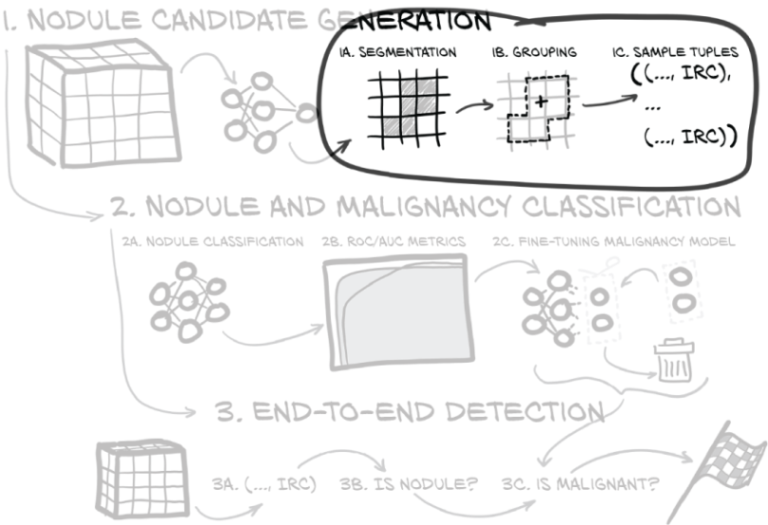
The nodule locations are combined back with the CT voxel data to produce nodule candidates, which can then be examined by our nodule classification model to determine whether they are actually nodules in the first place and, eventually, whether they’re malignant. This latter task is particularly difficult because malignancy might not be apparent from CT imaging alone, but we’ll see how far we get. Last, each of those individual, per-nodule classifications can then be combined into a whole-patient diagnosis.
Over the past several chapters, we have built a decent number of systems that are important components of our project. We started loading our data, built and improved classifiers for nodule candidates, trained segmentation models to find those candidates, handled the support infrastructure needed to train and evaluate those models, and started saving the results of our training to disk. Now it’s time to unify the components we have into a cohesive whole, so that we may realize the full goal of our project: it’s time to automatically detect cancer.
$ python3.6 -m p2ch14.nodule_analysis 1.3.6.1.4.1.14519.5.2.1.6279.6001.592821488053137951302246128864
...
found nodule candidates in 1.3.6.1.4.1.14519.5.2.1.6279.6001.592821488053137951302246128864:
nodule prob 0.533, malignancy prob 0.030, center xyz XyzTuple   #1(x=-128.857421875, y=-80.349609375, z=-31.300007820129395)
nodule prob 0.754, malignancy prob 0.446, center xyz XyzTuple(x=-116.396484375, y=-168.142578125, z=-238.30000233650208)
...
nodule prob 0.974, malignancy prob 0.427, center xyz XyzTuple   #2(x=121.494140625, y=-45.798828125, z=-211.3000030517578)
nodule prob 0.700, malignancy prob 0.310, center xyz XyzTuple(x=123.759765625, y=-44.666015625, z=-211.3000030517578)
...