concept scene in category deep learning

This is an excerpt from Manning's book Deep Learning with Structured Data.
Let’s take a closer look at what’s happening behind the scenes with web deployment. Figure 8.4 shows the flow through the stack from the user entering the details about their intended streetcar trip in home.html to the user getting a response displayed back in show-prediction.html. See the following list for more details on the numbered steps in Figure 8.6:

This is an excerpt from Manning's book Deep Learning with PyTorch.
The fun part is that at this point, we don’t need matched horse/zebra pairs as ground truths (good luck getting them to match poses!). It’s enough to start from a collection of unrelated horse images and zebra photos for the generators to learn their task, going beyond a purely supervised setting. The implications of this model go even further than this: the generator learns how to selectively change the appearance of objects in the scene without supervision about what’s what. There’s no signal indicating that manes are manes and legs are legs, but they get translated to something that lines up with the anatomy of the other animal.
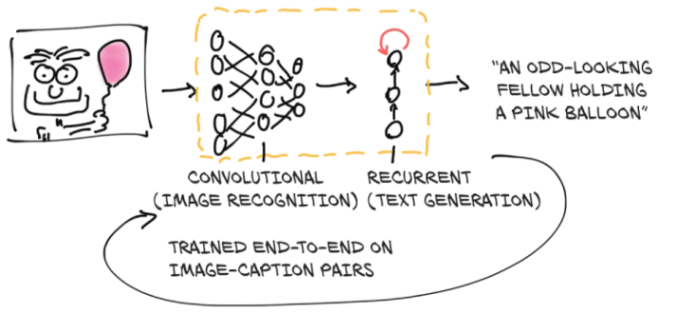
In order to get firsthand experience with a model involving natural language, we will use a pretrained image-captioning model, generously provided by Ruotian Luo.2 It is an implementation of the NeuralTalk2 model by Andrej Karpathy. When presented with a natural image, this kind of model generates a caption in English that describes the scene, as shown in figure 2.9. The model is trained on a large dataset of images along with a paired sentence description: for example, “A Tabby cat is leaning on a wooden table, with one paw on a laser mouse and the other on a black laptop.” 3
This captioning model has two connected halves. The first half of the model is a network that learns to generate “descriptive” numerical representations of the scene (Tabby cat, laser mouse, paw), which are then taken as input to the second half. That second half is a recurrent neural network that generates a coherent sentence by putting those numerical descriptions together. The two halves of the model are trained together on image-caption pairs.