concept streetcar delay prediction model in category deep learning

This is an excerpt from Manning's book Deep Learning with Structured Data.
The real question for us isn’t the broad question “how much data does a deep learning model need to be trained adequately?” but rather “is there enough data in the streetcar dataset to apply deep learning to it?” Ultimately, the answer to that question depends on how well our model performs, and there is a lesson in this observation. If you have a dataset with a size in the 10s of thousands like the streetcar dataset, it is neither so small that deep learning is out of the question nor big enough that you are guaranteed that data volume won’t be a problem. The only way to know for sure whether deep learning is applicable to your problem is to try it out and look at the performance. As described in Chapter 6, for the streetcar delay prediction model, we measure test accuracy (that is, for the subset of the dataset that is not used to train the model, what proportion of the records does the model accurately predict a delay) and other measurements that are connected to a good user experience with the model. The good news is that after you have completed this book you will have all the tools you need to assess the performance of deep learning on tabular structured datasets.
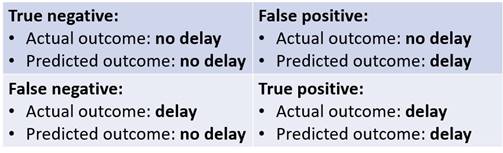
Figure 6.7 The four possible outcomes of the streetcar delay prediction model
Once you have added subroutes to the refactored dataset and retrained the model with this augmented dataset, you would also face the challenge of how to give the user the ability to define what subroutes of a given route they are travelling through. That is, to score with the revised model you would need to get start and end locations from the user for their trip. For the web deployment you could add a new control in home.html to allow the user to select the subroute for their trip. The user experience would not be ideal with web deployment, so what about enhancing the Facebook Messenger deployment to allow the user to specify a subroute? There are two approaches that you could take. First, you could enhance the Rasa model to allow the user to enter major cross-street names and then use the geocode API to translate the intersections of these streets with the streetcar route into latitude and longitude values. Second you could use the Facebook Messenger’s webview feature to display an interactive map widget in a web page that allows the user to select route points. Overall, adding subroutes to the streetcar delay prediction model would likely improve performance, but it would be non-trivial work to adapt the web deployment or the Facebook Messenger deployment to allow the user to specify the specific start and end points of their trip.