concept two vector in category deep learning

This is an excerpt from Manning's book Math and Architectures of Deep Learning.
Try moving an object at right angles to the direction in which you are pushing it. You will find it is impossible. In fact, the larger the angle, the less effective your force vector becomes (finally becoming totally ineffective at 90° angle). This is the reason why it is easy to walk on a horizontal surface (you are moving at right angles to the direction of gravitational pull, gravity vector is ineffective) but harder on an upwards incline (gravity vector is having some effect against you). These physical notions are captured mathematically in the notion of dot product. The dot product between two vectors
(say the push vector) and
(say the displacement of the pushed object vector) is ||
Two vectors are orthogonal if their dot product is zero. Geometrically, this means the vectors are perpendicular to each other. Physically, this means the two vectors are independent, one cannot influence the other. One can say, there is nothing in common between orthogonal vectors. For instance, the feature vector for d5 is
and that for d6 is

Figure 2.8: Any point
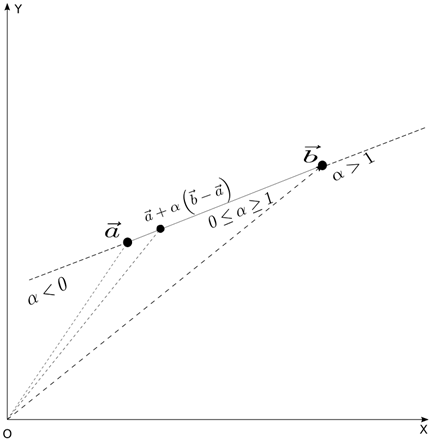
on the line joining two vectors