concept constructor injection in category dependency injection

This is an excerpt from Manning's book Dependency Injection: Design Patterns Using Spring and Guice.
This technique is called constructor injection and has the advantage of being explicit about its contract—you can never create an Emailer and forget to set its dependencies, as is possible in the earlier example if you forget to call the setSpellChecker() method. This concept is obviously very useful in OOP. We’ll study it in greater detail in the coming chapters.
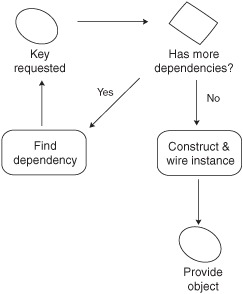
A constructor is something of an initialization hook and somewhat less than a method, even with a generous definition of methods. Constructors are provided in most object-oriented languages as a means of adequately preparing an object prior to use. The flow chart in figure 3.1 shows the steps taken internally to perform constructor injection.
This chapter was a real workout! First, we explored the injection idioms of setter, constructor, interface, and method decoration. Setter injection has advantages in being flexible, particularly if you don’t need every dependency set all of the time. However, it has significant drawbacks since fields can’t be made immutable (constant), which is important to preserving object graph integrity. Constructor injection is a compelling alternative, since it does allow you to set immutable fields. It is also useful since you can’t accidentally forget to set a dependency (such configuration fails early and fast). Constructor injection is also less verbose and prevents accidental overwriting of previously set dependencies.
Earlier, when describing constructor injection, we said that one of the purposes of a constructor was to “perform some initialization logic” on an object. This may be as simple as setting dependencies on fields or may involve some specific computation needed in order to prepare the object (for example, setting a window’s title). The constructor is a good place to put this because you can guarantee that any such logic is run prior to the object being used anywhere. If this computation is expensive, it is worthwhile performing it up front so you don’t encumber the object later on.