concept DI in category dependency injection
This is an excerpt from Manning's book Dependency Injection.
What purpose does DI serve? DI isn’t a goal in itself; rather, it’s a means to an end. Ultimately, the purpose of most programming techniques is to deliver working software as efficiently as possible. One aspect of that is to write maintainable code.
It’s a common misconception that DI is only relevant for this sort of scenario. That’s understandable, because DI enables this scenario. But the fallacy is to think that the relationship is symmetric. The fact that DI enables late binding doesn’t mean that it’s only relevant in late-binding scenarios. As figure 1.1 illustrates, late binding is only one of the many aspects of DI.
Figure 1.1 Late binding is enabled by DI, but to assume that it’s only applicable in late-binding scenarios is to adopt a narrow view of a much broader vista.


This is an excerpt from Manning's book Dependency Injection in .NET.
As figure 1.1 shows, this chapter is fairly linear in structure. First, I introduce DI, including its purpose and benefits. Although I include examples, overall, this chapter has less code than any other chapter in the book.
Figure 1.1. The structure of the chapter is fairly linear. You should read the first section before the next, and so on. This may seem obvious, but some of the later chapters in the book are less linear in nature.
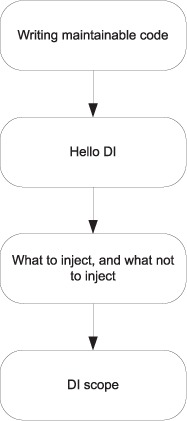
Before I introduce DI, I’ll discuss the basic purpose of DI: maintainability. This is important because it’s easy to misunderstand DI if you aren’t properly prepared. Next, after an example (Hello DI), I’ll discuss benefits and scope, essentially laying out a road map for the book. When you’re done with this chapter, you should be prepared for the more advanced concepts in the rest of the book.
To most developers, DI may seem like a rather backward way of creating source code, and, like sauce béarnaise, there’s much FUD involved. To learn about DI, you must first understand its purpose.
What purpose does DI serve? DI isn’t a goal in itself; rather, it’s a means to an end. Ultimately, the purpose of most programming techniques is to deliver working software as efficiently as possible. One aspect of that is to write maintainable code.
How is the previous example better than the usual single line of code we normally use to implement Hello World in C#? In this example, DI adds an overhead of 1,100%, but, as complexity increases from one line of code to tens of thousands, this overhead diminishes and all but disappears. Chapter 2 provides a more complex example of applied DI, and although that example is still overly simplistic compared to real-life applications, you should notice that DI is far less intrusive.
I don’t blame you if you find the previous DI example to be over-engineered, but consider this: by its nature, the classic Hello World example is a simple problem with well-specified and constrained requirements. In the real world, software development is never like this. Requirements change and are often fuzzy. The features you must implement also tend to be much more complex. DI helps address such issues by enabling loose coupling. Specifically, we gain the benefits listed in table 1.1.

This is an excerpt from Manning's book Dependency Injection: Design Patterns Using Spring and Guice.
Pedantic users of the term suggest that all of these cases are consistent with its definition and that DI itself is simply one instance of IoC.
DI can make your life easier, but like anything else, it requires careful thought and an understanding of pitfalls and traps and the available strategies for dealing with them. The appropriate choice of injection idiom and accompanying design patterns is significant in any architecture. Even if you were to disavow the use of a DI library altogether, you would do well to study the traps, pitfalls, and practices presented in this chapter. They will stand you in good stead for designing and writing healthy code.
Some code is beyond your control, either third-party libraries, frozen code, or code that can’t be changed for some other reasons (such as time constraints). You still need these components, so you need a way to bring them into a modern architecture with dependency injection. DI is really good at this work and at neutralizing such undulations in a large code base. One solution is to use external metadata (if your injector supports it) such as an XML file. This leaves the sealed classes unaffected but still provides them with requisite dependencies. However, if sealed code uses factories or unconventional setter methods, this may be difficult. In this case, the Adapter pattern is a powerful solution. You inject the Adapter as per usual, and then the Adapter decides how to wire the original component. Adapters are a strong solution because they can leave client code unaffected. They are also a transparent alternative to the reinjection problem, though they are sometimes verbose compared to providers.