concept Mary ’s application in category dependency injection
appears as: Mary’s application
This is an excerpt from Manning's book Dependency Injection.
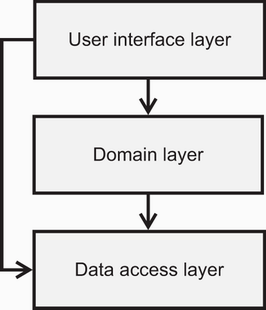
When working with solutions in Visual Studio, it’s easy to lose track of the important Dependencies. This is because Visual Studio displays them together with all the other project references that may point to assemblies in the .NET Base Class Library (BCL). To understand how the modules in Mary’s application relate to each other, we can draw a graph of the dependencies (see figure 2.6).
Figure 2.6 The dependency graph for Mary’s application, showing how the modules depend on each other. The arrows point towards a module’s dependency.
Parallel development — If we stick with the previous example of applying Cross-Cutting Concerns, it’s quite easy to understand that having to make sweeping changes throughout your code base hinders the ability to work with multiple developers in parallel on a single application. Like us, you’ve likely dealt with painful merge conflicts in the past when committing your work to a version control system. A well-designed, loosely coupled system will, among other things, reduce the amount of merge conflicts that you’ll have. When more developers start working on Mary’s application, it’ll become harder and harder to work effectively without stepping on each other’s toes. Testability — We already established that swapping out the data access layer is currently impossible. Testing code without a database, however, is a prerequisite for doing unit testing. But even with integration testing, Mary will likely need some parts of the code to be swapped out, and the current design makes this hard. Mary’s application is, therefore, not Testable.