concept new in category dependency injection
This is an excerpt from Manning's book Dependency Injection.
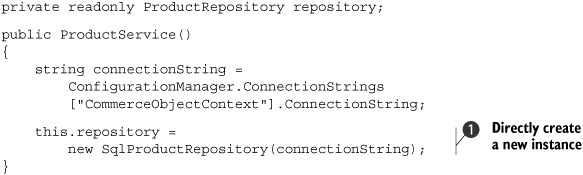
One of the many reasons that it’s so easy to write tightly coupled code is that both the language features and our tools already pull us in that direction. If you need a new instance of an object, you can use the
newkeyword. If you don’t have a reference to the required assembly, Visual Studio makes it easy to add. But every time you use thenewkeyword, you introduce a tight coupling. As discussed in chapter 1, not all tight coupling is bad, but you should strive to prevent tight coupling to Volatile Dependencies.
As an example, the Control Freak anti-pattern happens when you create a new instance of a Volatile Dependency by using the
newkeyword. The following listing demonstrates an implementation of the Control Freak anti-pattern.Listing 5.1 A Control Freak anti-pattern example
public class HomeController : Controller
{
    public ViewResult Index()
    {
        var service = new ProductService();    #1

        var products = service.GetFeaturedProducts();
        return this.View(products);
    }
}

#1   HomeController creates a new instance of the Volatile Dependency, ProductService, causing tightly coupled code.
Every time you create a Volatile Dependency, you explicitly state that you’re going to control the lifetime of the instance and that no one else will get a chance to Intercept that particular object. Although the
newkeyword is a code smell when it comes to Volatile Dependencies, you don’t need to worry about using it for Stable Dependencies.2
This is an excerpt from Manning's book Dependency Injection in .NET.
In the context of managing dependencies, INVERSION OF CONTROL accurately describes what we’re trying to accomplish. In Mary’s application, the code directly controls its dependencies: when the ProductService needs a new instance of the CommerceObjectContext class, it simply creates an instance using the new keyword. When the HomeController needs a new instance of the ProductService class, it, too, news up an instance. The application is in total control. That may sound powerful, but it’s actually limiting. I call this the CONTROL FREAK anti-pattern. INVERSION OF CONTROL instructs us to let go of that control and let something else manage the dependencies.